

Himeji Castle
Interactive 3D Scan
Explore 3D Model
Click to load interactive scan
HIMEJI CASTLE Himeji City, Hyogo Prefecture, Japan · Original 1333 CE; main tower complex 1601–1609 CE · Japanese Feudal Castle Architecture STABLE
SITE AT A GLANCE Location: Himeyama hill, Himeji city, Hyogo Prefecture, Japan Country: Japan Region: East Asia Coordinates: 34.8394° N, 134.6939° E Type: Tangible Cultural Heritage — Military Architecture Sub-types: Feudal Castle, Built Heritage, National Treasure Period: Fortification from 1333 CE; current complex 1601–1609 CE; continuously maintained Risk Level: Stable Risks: Seismic vulnerability, Timber conservation, Tourism volume, Plaster weathering, Fire risk UNESCO Status: UNESCO World Heritage Site (1993)
DESCRIPTION The genius of Himeji Castle's defensive design is its disguise. Approaching from the south, a visitor sees only the white towers rising above the trees — a direct path appears to lead to the main gate. In reality, the approach path spirals around the hill in an intricate maze of gates (there are 84 gates in the complex), turns, and corridors that force an attacker to expose their flank at every junction. The castle's interior paths were designed to disorient attackers who breached the outer defences; an attacking force unfamiliar with the layout would find themselves in dead ends, exposed to fire from walls on three sides. The white plaster finish is not merely decorative. The namamabashira-shikkui (rough plaster over clay) coating covers every exterior wooden surface — walls, window shutters, even the decorative gables — to a thickness of several centimetres. This plaster is the castle's primary fire resistance: during the sengoku period of constant warfare, fire from flaming arrows was the primary siege weapon, and the plaster coating made the castle's wooden structure far more resistant to fire than uncoated timber. The brilliant whiteness is the visual expression of a practical defence strategy. The main tower's timber frame is a masterpiece of Japanese carpentry. The six-storey structure uses a central pillar system (shin-bashira) — two enormous timber pillars running from the basement to the top storey — as the structural spine, with the floor systems hung from this central frame rather than supported from below. This system gives the structure seismic flexibility: the building can sway with an earthquake rather than resisting rigidly and fracturing.
HISTORICAL SIGNIFICANCE Himeji Castle was constructed at one of the most significant moments in Japanese history. The late Sengoku period (1467–1615) — the century of constant civil war between competing daimyo — was ending. Toyotomi Hideyoshi's near-unification of Japan in the 1580s and 1590s, and then Tokugawa Ieyasu's final victory at the Battle of Sekigahara (1600), were transforming the political landscape from constant warfare to the enforced peace of the Edo period. The castle was built by Ikeda Terumasa between 1601 and 1609 — precisely in the years when the military function of castles was being superseded by their administrative and symbolic functions. Himeji is in this sense a monument to the end of the era it embodies: a perfect military machine built at the moment when military machines were becoming unnecessary. The castle's survival through the 20th century is remarkable. In June 1945, US firebombing raids struck Himeji city. The castle was not hit — accounts vary between attributing this to a targeting error, to the bomb on the main keep being a dud that did not detonate, and to the smoke from surrounding fires obscuring it from bombers' view. The surrounding city was largely destroyed; the castle stood.
THE STORY OF THE MONUMENT
1333 CE: Original Fortification Akamatsu Norimura builds a fortification on Himeyama hill during the Nanboku-chō period of civil conflict — the site's first defensive use.
1581: Toyotomi Hideyoshi's Reconstruction Toyotomi Hideyoshi, the warlord in the process of unifying Japan, substantially rebuilds the castle complex during his campaign against the western provinces.
1601–1609: Ikeda Terumasa's Construction Ikeda Terumasa, rewarded with the Harima domain for his support at Sekigahara, builds the main tower complex and the majority of the surviving 83 buildings in a massive construction programme. This is the castle that survives today.
1617–1749: Honda and Sakai Domain Periods The castle changes hands through the Edo period, maintained as the administrative centre of the Himeji domain. The defensive function recedes; the administrative and symbolic function becomes primary.
1868–1871: Meiji Restoration The Meiji government's dismantling of the feudal order leads to proposals to demolish the castle. It is saved by the intervention of the Japanese army, which uses it as a military garrison, and later by public recognition of its historical significance.
1945: Wartime Survival US firebombing of Himeji city in June 1945 destroys much of the surrounding area. The castle survives intact.
1956–1964: Daishu Repair (Major Post-war Restoration) A major structural restoration is undertaken, disassembling and reassembling the main tower to address deterioration and damage.
1993: UNESCO World Heritage Inscription Himeji Castle is inscribed on the UNESCO World Heritage List alongside the Buddhist Monuments in the Horyu-ji Area.
2009–2015: Heisei Restoration A major six-year restoration project replasters the entire main tower exterior and addresses structural issues. The castle is closed to visitors for part of this period; it reopens in 2015 with a brilliant white that gradually weathers to its more familiar soft cream tone.
THREATS AND RISK ASSESSMENT Himeji Castle's institutional situation is excellent. It is one of Japan's most important cultural properties — designated both a National Treasure and a UNESCO World Heritage Site — with significant government resources devoted to its maintenance. The craftsmanship required for its maintenance — traditional Japanese carpentry, traditional plaster, traditional roof tile work — is supported by active training programmes for specialist craftspeople. The primary physical risk is seismic. The 1995 Great Hanshin earthquake (magnitude 7.3), centred near Kobe approximately 50 kilometres away, caused minor damage to some of the surrounding walls and structures. A larger event closer to Himeji could pose more serious risks, though the timber frame's seismic flexibility is a significant protective factor.
IF NOTHING CHANGES Himeji Castle will continue to be maintained, restored, and visited. The tradition of specialist maintenance craft will be sustained by Japan's institutional commitment. The seismic risk will remain a background concern that cannot be entirely mitigated. The castle will remain, as it has been since its completion in 1609, the finest surviving example of Japanese feudal architecture — intact, functional as a public heritage site, and maintained with a level of craft attention that most ancient buildings in the world cannot approach.
Screening Room

Himeji Castle — Japan's Greatest Samurai Fortress

Inside Himeji Castle — Architecture and History
Historical Timeline
Original Fortification
Akamatsu Norimura builds the first fortification on Himeyama hill.
Hideyoshi's Reconstruction
Toyotomi Hideyoshi substantially rebuilds the castle during his unification campaigns.
Ikeda Terumasa's Construction
The main tower complex and the majority of the 83 surviving buildings are constructed in a single massive programme.
Wartime Survival
US firebombing destroys much of Himeji city; the castle survives intact.
UNESCO Inscription
Himeji Castle inscribed on the UNESCO World Heritage List.
Heisei Restoration
Major six-year restoration replasters the entire exterior and addresses structural issues.
Quick Facts
Location
Himeji city, Hyogo Prefecture, Honshu, Japan; on a hilltop (Himeyama) in the Harima Plain, 50 kilometres west of Kobe
Country
Japan
Region
East Asia
Period
Original fortification on the site attributed to Akamatsu Norimura, 1333 CE; major castle construction by Toyotomi Hideyoshi 1581; current main tower complex built by Ikeda Terumasa 1601–1609 CE; UNESCO World Heritage Site since 1993
Type
Built Heritage
Risk Level
Safe
Related Heritage Sites
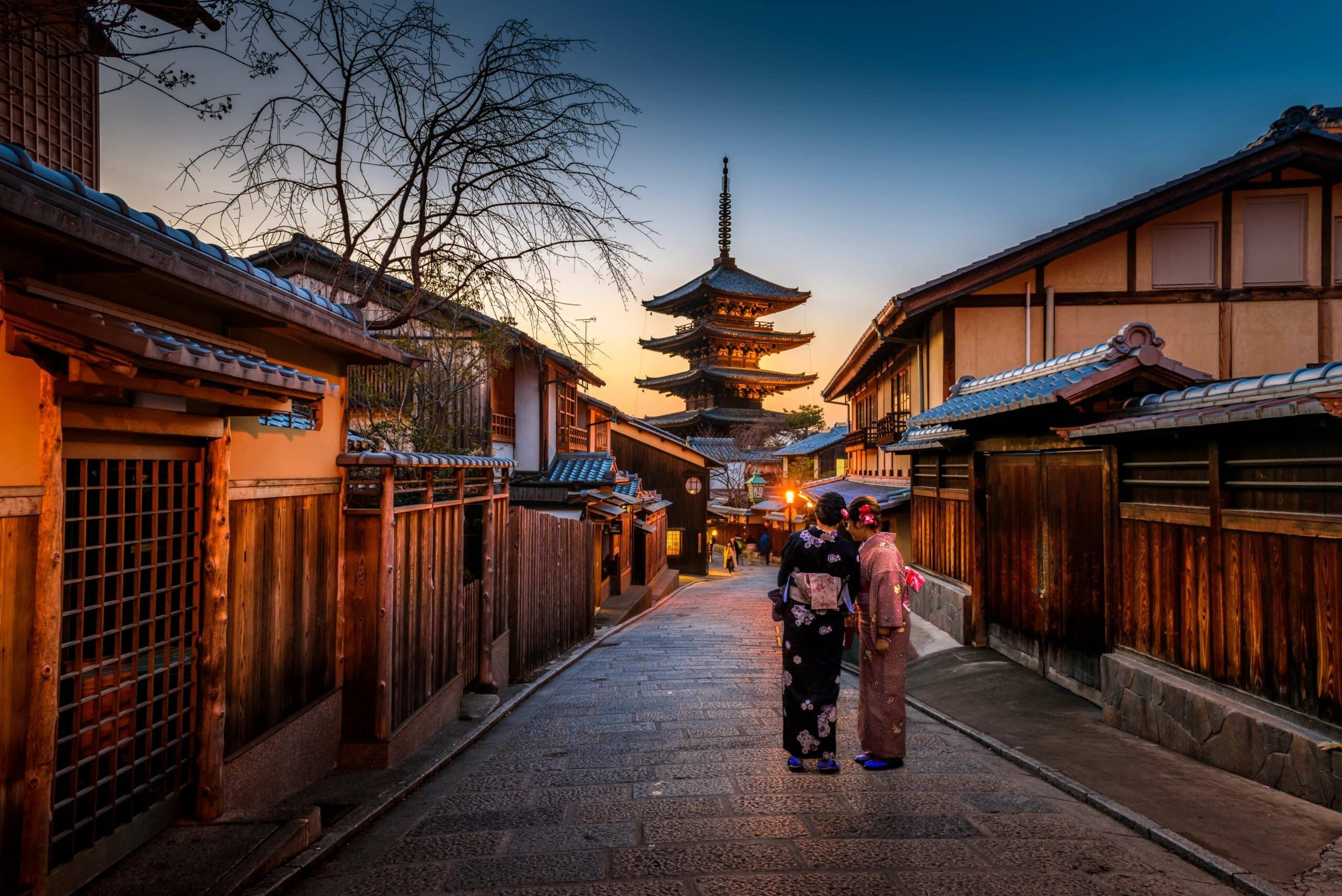
Ancient Kyoto
Ancient Kyoto encompasses seventeen historic monuments across three cities — temples, shrines, palaces, and gardens that constitute Japan's most complete surviving expression of imperial court culture. Japan's imperial capital for over a thousand years, it received 50 million visitors in 2019 — ten times its resident population. The machiya, traditional wooden townhouses that once formed the domestic fabric of the city, are disappearing at approximately 2% per year, taking with them the living trades — textile dyeing, lacquerwork, confectionery — that give the monuments their cultural context.

Great Wall of China
The Great Wall of China is not a single wall but a 21,196-kilometre system of walls, fortifications, watchtowers, and garrison stations built over more than two millennia. It is one of the greatest construction projects in human history, built at incalculable human cost. A 2012 government survey found that 74% of its Ming-era sections have been damaged or destroyed — most through the quiet, centuries-long process of rural communities using its bricks as a quarry.

Gyeongbokgung Palace
Gyeongbokgung Palace (景福宮, 'Greatly Blessed by Heaven') was the primary palace of the Joseon dynasty (1395–1910) — the largest, most architecturally significant, and most historically resonant of Seoul's five royal palaces. At its height in the 16th century, the complex covered approximately 400,000 square metres and contained more than 500 buildings connected by elevated corridors and arranged according to strict Confucian spatial hierarchies: the state throne hall (Geunjeongjeon) for royal audiences, the private royal living quarters (Gangnyeongjeon and Gyotaejeon), the government offices, the royal ancestral shrines, and the extraordinary Gyeonghoeru Pavilion — a 48-pillar stone-based pleasure pavilion built on an artificial island in a lotus pond. Japanese colonial demolition (1895–1910) reduced the complex from more than 500 buildings to 36; the ongoing restoration programme begun in 1990 aims to return the complex to its pre-colonial completeness.