

Galápagos Islands
Interactive 3D Scan
Explore 3D Model
Click to load interactive scan
Overview
The Galápagos Islands became famous because of what Charles Darwin saw there — and what he saw there was the consequence of what the islands are: a group of oceanic volcanic peaks, isolated from the South American mainland by nearly 1,000 kilometres of open Pacific, where the animals that arrived had nowhere to go but here and nothing to compete with but each other. In the absence of mainland predators, species lost the behaviours that predator pressure maintains — the wariness of human presence that makes wildlife elsewhere so difficult to approach. The blue-footed booby that stands and watches you with mild curiosity is not tame. It simply has no evolved reason to fear you.
That ecological innocence is not a metaphor. It is a measurable characteristic of the wildlife of the Galápagos, and it is one of the things most directly threatened by the changes the islands have undergone since Darwin visited in 1835. Humans bring predators with them — rats in cargo, cats that become feral, pigs that root up nesting sites. They also bring plants, insects, and microorganisms that the islands' endemic species have no evolutionary experience of. The result, playing out across the archipelago over two centuries of increasing human contact, is a slow-motion ecological disruption that targeted conservation work has slowed but not stopped.
The Story of the Galápagos
4 to 5 Million Years Ago — Volcanoes Rise from the Pacific
The Galápagos Archipelago was built by a geological process still active today. The Nazca tectonic plate is moving slowly eastward over a stationary volcanic hotspot — the same mechanism that built the Hawaiian Islands — producing a sequence of volcanic peaks that emerge from the ocean floor, rise above sea level, and then slowly sink back below it as the plate carries them away from the hotspot and into deeper water. The western islands — Isabela and Fernandina — are the youngest and most volcanically active. The eastern islands are older, their volcanic cones eroded and their soils more developed. The pattern of geological age across the archipelago is directly reflected in the pattern of ecological development.
The Great Arrivals — Life Colonises the Islands
Every organism on the Galápagos arrived from elsewhere — carried across nearly 1,000 kilometres of open ocean by wind, current, or luck. The probability of successful colonisation was vanishingly small for any individual. Over millions of years, enough individuals arrived to establish populations, and in the isolation of an oceanic archipelago, those populations began to diverge. The finches that became Darwin's finches arrived as one or a few ancestral species from South America and radiated across the available ecological niches — seed-eaters, cactus-feeders, insect-catchers — producing 14 species distinguished primarily by beak morphology adapted to different food sources. The marine iguanas evolved from land iguana ancestors, developing the capacity to dive in cold ocean waters and graze on algae from submerged rocks — a lifestyle with no parallel among other iguanas anywhere. The penguins arrived from the south, carried by the cold Humboldt Current, and established the only equatorial penguin population in the world.
1535 to 1800 CE — Human Discovery and Ecological Disruption Begins
The first humans to visit the Galápagos — Bishop Tomás de Berlanga's accidentally windblown Spanish expedition in 1535 — left no permanent settlement but introduced the first suggestion of the impact that human contact would have. The subsequent two centuries of pirate and buccaneer activity, whaling, and occasional scientific visits extracted giant tortoises from the islands in large numbers — they were taken alive as a food source, capable of surviving months without food or water in a ship's hold. Estimates of the number of tortoises removed during the nineteenth century alone reach into the hundreds of thousands. The species' slow reproductive rate, combined with this extraction pressure and the introduction of mainland animals that preyed on eggs and young, drove several tortoise subspecies to extinction and reduced others to tiny remnant populations.
1835 — Darwin Arrives
Charles Darwin reaches the Galápagos on September 15, 1835, aboard HMS Beagle and spends five weeks visiting four of the main islands. He is not, at this point, thinking about natural selection — that theoretical framework will not emerge fully for another two decades. He is a young naturalist on a round-the-world voyage, collecting specimens with the systematic enthusiasm of his training. He notes that the tortoises differ between islands, and the Vice Governor of the islands tells him that he can identify which island a tortoise comes from by its shell. He notes that the mockingbirds seem to differ between islands. He catches, labels, and ships specimens without yet understanding the theoretical significance of the variation he is documenting. It is only after his return to England, when the ornithologist John Gould examines his bird specimens and identifies them as distinct species rather than varieties, that Darwin begins to understand what he has seen.
1959 — Protection Arrives
Ecuador declares 97% of the land area of the Galápagos a national park in 1959, the centennial year of Darwin's Origin of Species. The Charles Darwin Research Station is established on Santa Cruz Island the same year, beginning the scientific monitoring and species recovery work that continues today. The founding of the National Park and Research Station represents the beginning of modern conservation engagement with the islands, and the combination of protected area status, scientific monitoring, and international attention that it established has been the framework within which all subsequent conservation work has operated.
1978 to 2001 — World Heritage Status
The Galápagos was among the first sites inscribed on the UNESCO World Heritage List in 1978. The marine reserve was added to the inscription in 2001, extending protection to the extraordinary marine biodiversity of the surrounding ocean — sea lions, sharks, rays, sea turtles, and fish species of remarkable abundance and diversity — that is as ecologically significant as the terrestrial wildlife.
2007 — UNESCO Sounds the Alarm
UNESCO places the Galápagos on the List of World Heritage in Danger in 2007, citing the combined pressures of invasive species, unsustainable tourism growth, and increasing immigration of workers from mainland Ecuador whose arrival rate was exceeding the capacity of biosecurity systems to screen for invasive organisms. The listing triggered a significant government response, including tightened immigration controls, accelerated invasive species management, and increased resources for the Galápagos National Park Directorate. The site was removed from the Danger List in 2010 — a recognition of real progress, though the underlying pressures have continued.
Today — A Conservation Success Story with an Unresolved Core Problem
The Galápagos is, by any fair assessment, one of the conservation world's significant success stories. The goat eradication programme on Isabela Island — the largest such eradication ever undertaken, removing more than 150,000 goats from a single island — is a landmark achievement of applied conservation science. The Galápagos giant tortoise, several subspecies of which were reduced to tiny remnant populations, is recovering through captive breeding and reintroduction programmes. The Waved Albatross continues to breed on Española Island. The marine iguana colony, despite severe El Niño mortality events, persists. These are real and hard-won outcomes.
The unresolved core problem is the economic model of the islands, which is built around tourism and fishing in ways that create structural pressure on the ecosystem. A thriving tourism economy requires flights, ferries, hotels, restaurants, and the supply chains to service them. Every supply chain is a biosecurity risk. Every new worker who arrives from the mainland is a potential vector for invasive species. Every hotel generates waste. The economic incentive to accommodate more visitors runs continuously against the ecological interest in accommodating fewer.
Threats and Risk Assessment
Invasive Species remain the most persistent and ecologically damaging ongoing threat. Rats, cats, dogs, pigs, and goats have been successfully eradicated from some islands. On the larger, more inhabited islands — Santa Cruz, San Cristóbal, Isabela — eradication is much more difficult because human settlement creates refuges for invasive species that are hard to eliminate without affecting residents. Fire ants have been introduced and are spreading. Invasive plants are displacing native vegetation across disturbed areas. The biosecurity system at airports and ports has improved significantly but remains imperfect.
El Niño Events and Climate Change — El Niño events warm the ocean waters around the Galápagos and disrupt the cold-water upwelling that brings nutrients to the surface and sustains the marine food chain. During severe El Niño years, marine iguana populations can lose 60–70% of their individuals through starvation as the algae they feed on dies off in warm water. Sea lions starve. Penguin breeding collapses. The 1982–83 and 1997–98 El Niños were severe. Climate change is expected to intensify the frequency and severity of these events, and to raise baseline ocean temperatures in ways that will make the periods between events harder for marine species.
Ocean Acidification — the absorption of atmospheric CO₂ by seawater is reducing ocean pH globally, with direct effects on the calcification of marine organisms including the coral species that form reef structures in Galápagos waters. The pace and magnitude of this change is well documented and clearly attributable to global greenhouse gas emissions that cannot be managed locally.
Illegal Fishing — the Galápagos Marine Reserve, at 133,000 square kilometres one of the largest marine protected areas in the world, cannot be effectively patrolled with current resources. Illegal fishing — both by Ecuadorian vessels operating without permits and by fleets from other nations — removes species that the endemic marine wildlife depends on and creates incentives for the continuing pressure on resources within the reserve boundaries.
Research and Scholarly Context
The Galápagos has been one of the most intensively studied natural ecosystems in the world for more than a century, and the volume of research it has generated spans evolutionary biology, ecology, oceanography, geology, and conservation science. The long-term monitoring programmes run by the Charles Darwin Foundation and the Galápagos National Park Directorate have produced baseline datasets of extraordinary value, documenting population trends for dozens of species across periods long enough to distinguish climate-driven variation from directional change.
Research into the mechanisms of adaptive radiation — the process by which a small number of founding species diversify into ecological niches — has advanced significantly using the Galápagos as a primary study system. Genomic analysis of Darwin's finches has revealed the molecular basis of the beak variation that Darwin observed, identifying specific genes whose expression patterns determine beak shape and demonstrating the evolutionary speed with which these traits can shift in response to food availability. This work has direct relevance to understanding how species will respond to the rapid environmental changes that climate change is imposing.
Oceanographic research around the Galápagos has documented the interactions between the three major current systems — the Humboldt, the Cromwell, and the Panama — that determine the temperature, nutrient content, and biological productivity of the surrounding waters. The research has established the mechanisms through which El Niño events disrupt these systems and produced models that predict the consequences for endemic marine species with increasing accuracy.
If Nothing Changes
The Galápagos will not empty of endemic species in a single catastrophic event. The trajectory is slower and in some ways more difficult to communicate: a gradual reduction in population sizes, the loss of individual islands' distinctiveness as invasive species spread and endemic species retreat, the degradation of marine productivity as ocean temperatures rise and acidification increases, the replacement of distinctive Galápagos ecological communities with the generalised, invasive-species-dominated ecosystems that cover most of the human-influenced world.
The conservation work that has been done — the eradications, the breeding programmes, the marine protection — is real and it matters. It has bought time and it has recovered species that would otherwise be gone. The question is whether it can be scaled and sustained at the level needed to address threats whose drivers — climate change, ocean acidification, the economic dynamics of a tourism-dependent island economy — operate at scales well beyond what local conservation management can directly control.
The answer the Galápagos gives to that question will not be available for decades. By the time it becomes clear, it will be too late to change it.
Screening Room

Our Planet: Islands
Historical Timeline
Islands Form
Volcanic hotspot activity creates the archipelago through successive eruptions on the Nazca tectonic plate.
First Human Contact
Bishop Tomás de Berlanga accidentally discovers the islands; his account describes the giant tortoises and tame wildlife.
Darwin's Visit
Charles Darwin spends five weeks across the archipelago aboard HMS Beagle, making the observations that contribute to his theory of natural selection.
National Park Established
Ecuador declares 97% of the land area a national park; the Charles Darwin Research Station is founded the same year.
UNESCO Inscription
First site inscribed on the World Heritage List; marine reserve added in 2001.
In Danger Listing
UNESCO places the Galápagos on the In Danger list due to invasive species, tourism growth, and immigration pressures.
Removed from In Danger List
Removed following government action on biosecurity and invasive species control, though underlying pressures remain.
Quick Facts
Location
Eastern Pacific Ocean, 973 kilometres west of continental Ecuador, straddling the equator
Country
Ecuador
Region
South America
Period
Formed approximately 4–5 million years ago through volcanic hotspot activity; first human contact 1535 CE; UNESCO inscription 1978
Type
Natural Heritage
Risk Level
At Risk
Related Heritage Sites
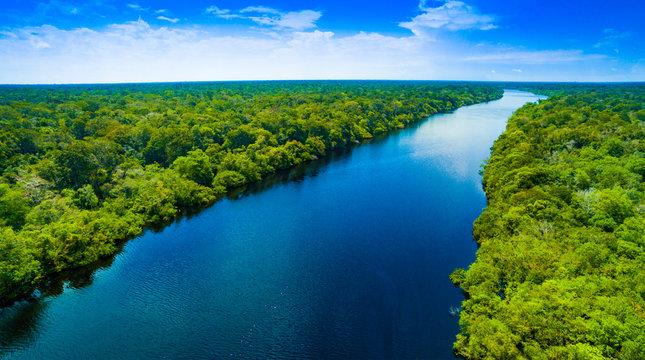
Amazon Rainforest
The most complex and biodiverse terrestrial ecosystem on earth, containing approximately 10 percent of all species on the planet within 5.5 million square kilometres of living forest, home to approximately 400 Indigenous nations speaking around 300 languages, holding an estimated 150 to 200 billion tonnes of carbon in its biomass and soils, and currently approaching a scientifically projected tipping point beyond which large areas may transition irreversibly toward savannah.

Machu Picchu
A fifteenth-century Inca royal estate and ceremonial centre set dramatically upon granite outcrops at the crest of a cloud-forested mountain ridge in the Peruvian Andes, defined by sophisticated dry-stone masonry, terraced agricultural platforms, temples, plazas, and an extraordinary ancient water management system — positioned within a sacred landscape of mountains, rivers, and celestial alignments of profound cosmological significance to the Inca civilisation.

Rapa Nui
A small triangular volcanic island in the middle of the Southeast Pacific, the most isolated inhabited place on earth — 3,700 kilometres from the Chilean mainland and 2,000 kilometres from the nearest inhabited land. Famous for approximately 300 ahu ceremonial stone platforms and the moai ancestor figures they once carried, some reaching over 10 metres in height and 80 tonnes in weight, distributed across the island in a landscape-scale political and territorial system of extraordinary sophistication. The easternmost point of Polynesian settlement and the final destination of one of the most remarkable episodes of human navigation in prehistory.