
Amazon Rainforest
Interactive 3D Scan
Explore 3D Model
Click to load interactive scan
Amazon Rainforest
Site Description
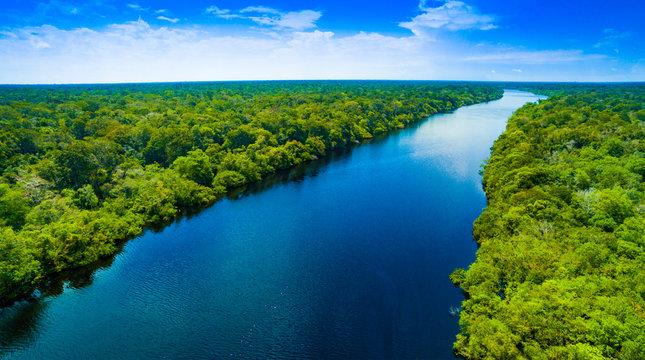
The Amazon Rainforest is not a heritage site in the conventional sense, and including it alongside Pompeii and Stonehenge requires a moment of explanation. It has no walls, no inscriptions, no founding emperor. What it has is approximately 10 percent of all species on earth packed into 5.5 million square kilometres of living forest, the largest river system in the world by discharge volume, an Indigenous cultural history stretching back at least 13,000 years, and a role in regulating the global climate that makes it, in the most literal sense, infrastructure for human civilisation on a planetary scale.
The scale defeats ordinary description. The Amazon River and its tributaries drain an area the size of the contiguous United States, moving approximately 20 percent of all the fresh water that flows into the world's oceans. The forest it waters contains an estimated 390 billion individual trees of approximately 16,000 species, roughly 2.5 million species of insects, 1,300 species of birds, 3,000 species of fish, and a total biodiversity that science has not yet fully inventoried. New species are described from the Amazon at a rate of several hundred per year.
The forest is also a carbon store of global significance, holding an estimated 150 to 200 billion tonnes of carbon in its biomass and soils. When it burns or is cleared, that carbon enters the atmosphere. When it is intact, it absorbs carbon dioxide and produces the moisture recycling that generates the rainfall on which the agricultural economies of southern South America depend.
Within and across the forest, approximately 400 Indigenous nations live, speaking around 300 languages, representing cultural and linguistic diversity of a kind that exists nowhere else on earth. They are also, in most of the countries where they live, the most effective guardians of the forest itself: deforestation rates are consistently lower in Indigenous territories than in adjacent areas under any other management regime.
Historical Significance
The Amazon was not the empty wilderness that European colonisers imagined and that their descendants continued to assume well into the twentieth century. Archaeological evidence accumulated over the past three decades has demonstrated that the Amazon was home to large, sophisticated, and spatially extensive pre-Columbian societies that substantially modified the landscape and managed it with considerable intentionality. The terra preta soils found across wide areas of the Amazon basin — dark, carbon-rich, extraordinarily fertile soils that are clearly anthropogenic in origin — are the most visible evidence of these societies, supplemented by the discovery of extensive earthwork systems, road networks, settlement mounds, and geoglyphs that are only now being fully mapped.
The diseases brought by European contact in the sixteenth and seventeenth centuries killed an estimated 90 percent of the Amazon's Indigenous population within a century of first contact, a demographic catastrophe so severe that it may have caused a measurable reduction in atmospheric carbon dioxide as the farmland and managed landscapes of the depopulated societies reverted to forest. What European explorers encountered as primeval wilderness was in many cases a landscape of recovery from one of the most devastating pandemics in human history.
The Amazon's significance for the future is if anything greater than its significance as a record of the past. Destroying it before that knowledge is developed is the heritage equivalent of burning a library whose contents have not been catalogued.
Threats and Risk Assessment
Deforestation and Agricultural Expansion
The primary and dominant threat to the Amazon is the deliberate clearance of forest for cattle ranching, soy production, and other agricultural uses, driven by Brazilian and global demand for beef and agricultural commodities. The economic incentives driving deforestation are substantial, and the enforcement of environmental legislation in a basin the size of the contiguous United States is logistically and politically difficult. Illegal deforestation accounts for a significant proportion of total forest loss and has been tacitly tolerated during periods of weak environmental enforcement.
Illegal Mining
Illegal gold mining, known as garimpo, has expanded dramatically in recent years, particularly in Indigenous territories where it is explicitly prohibited. The environmental damage goes beyond the direct clearing of forest: mercury used in gold processing contaminates river systems across wide areas, affecting both aquatic ecosystems and the health of Indigenous and riverine communities who depend on fish as a primary protein source.
Climate Change and Drought
The Amazon is entering a period of increasing climatic stress independently of deforestation. The severe droughts of 2005, 2010, 2015, and 2023 have each caused tree mortality and wildfire across large areas. The interaction between drought stress and the reduced moisture recycling caused by deforestation creates a compounding effect: less forest means less rainfall, which stresses the remaining forest, which reduces its resilience to further deforestation and drought.
Infrastructure Development
Road construction, dam building, and mining infrastructure open previously inaccessible forest areas to deforestation and illegal activity. Their effects extend far beyond their direct footprint through the access they provide to settlers, loggers, and miners.
Indigenous Rights and Territorial Security
The most effective conservation tool in the Amazon is secure Indigenous land tenure. Deforestation rates in legally recognised and effectively defended Indigenous territories are substantially lower than in adjacent areas under any other management regime — a finding robust enough to be considered settled evidence in conservation science. Strengthening Indigenous land rights is not just a matter of social justice but of conservation effectiveness.
Research and Scholarly Context
The research literature on the Amazon spans ecology, anthropology, archaeology, climate science, conservation biology, and political economy, and it has been transformed in the past two decades by the combination of new remote sensing capabilities and new archaeological methods.
The discovery and documentation of Amazonian Dark Earths, the terra preta soils, and their association with pre-Columbian societies of considerable scale and sophistication has required a fundamental revision of the standard narrative of Amazon prehistory. Research by Anna Roosevelt, Eduardo Viveiros de Castro, Michael Heckenberger, and many others has established that the Amazon was not the wilderness that European colonisers encountered but a managed landscape supporting large populations whose societies were complex, diverse, and in many cases environmentally sustainable in ways that industrial agriculture is not.
Climate science research has produced the tipping point framework that now defines the most urgent conservation argument for the Amazon. Research by Carlos Nobre, Thomas Lovejoy, and colleagues has combined deforestation data with climate modelling to estimate the threshold beyond which self-reinforcing drying and forest loss becomes the dominant dynamic.
If Nothing Changes
The tipping point scenario is not a hypothesis. It is a scientifically grounded projection of what happens when deforestation and climate stress together push the Amazon's moisture recycling system below the threshold needed to sustain the forest. At or beyond that point, dieback becomes self-reinforcing, the forest transitions toward savannah across large areas of the eastern and southern Amazon, and the carbon stored in the dying trees enters the atmosphere in quantities that make the global climate targets agreed in Paris effectively unachievable.
The consequences extend far beyond Brazil. The agricultural regions of southern Brazil, Paraguay, and Argentina depend on the moisture generated by the Amazon. The global carbon budget depends on the Amazon remaining a carbon sink rather than becoming a carbon source. The pharmaceutical, agricultural, and ecological services the forest provides to human civilisation globally have no substitute.
The Amazon does not need to be discovered or appreciated. Its value is understood by scientists, by the people who live in it, and by anyone who has engaged with the evidence. What it needs is the political will — at the national level in the countries where it exists and at the international level in the trade and climate agreements that shape the economic incentives driving its destruction — to treat its survival as a non-negotiable condition of a liveable planet. If it matters to you, that is where the argument needs to be made and where the pressure needs to be applied.
Historical Timeline
First Human Arrival
The ancestors of the Amazon's Indigenous peoples arrive in South America and over the following millennia disperse into and adapt to the diverse ecological zones of the continent. The earliest clear evidence of human presence in the Amazon dates to around 11,000 BCE, and the subsequent development of cultures adapted to the forest environment represents one of the most remarkable processes of ecological and cultural coevolution in human prehistory.
Complex Societies of the Amazon
Archaeological evidence, much of it recovered only in the past two to three decades, demonstrates that the Amazon was home to large and sophisticated societies for thousands of years before European contact. Earthwork systems covering hundreds of square kilometres, terra preta soils transformed by sustained human management, and elaborate ceramic traditions all point to complex, densely populated pre-Columbian civilisations that left deep marks on the landscape.
European Contact and the First Descriptions
Francisco de Orellana's expedition descends the Amazon from the Andes to the Atlantic, producing the first European account of the river. Friar Gaspar de Carvajal's account describes densely populated riverbanks with large towns and complex political hierarchies — a description dismissed for centuries as exaggeration that archaeological research has since demonstrated was accurate.
Collapse of Indigenous Societies
European diseases, primarily smallpox, measles, and influenza, move through the Amazon's Indigenous populations with catastrophic speed. Mortality rates reach 70 to 90 percent across most of the basin within a century of first contact. Societies that took thousands of years to develop collapse within decades. The forest recovers the managed landscapes of the depopulated societies, creating the wilderness that later European explorers would mistake for primeval nature.
The Rubber Boom
The industrial demand for rubber transforms the Amazon economy and triggers one of the most brutal episodes of colonial exploitation in South American history. The rubber barons force Indigenous and mestizo workers to collect rubber under conditions of systematic violence that kill hundreds of thousands of people. The boom ends when British-smuggled rubber seeds establish plantations in Southeast Asia, leaving behind a legacy of exploitation and environmental damage.
Road Building and the Opening of the Forest
The Brazilian military government's programme of Amazonian development, including the construction of the Transamazon Highway, initiates the modern phase of deforestation. The ideology of the Amazon as an empty space available for exploitation drives policies that displace Indigenous communities and create the infrastructure that allows large-scale deforestation to occur at industrial rates.
Chico Mendes Assassinated
Forest activist and rubber tapper union leader Chico Mendes is assassinated by ranchers in December 1988, his murder drawing international attention to the conflict between forest communities and the agricultural and ranching interests driving deforestation. Mendes becomes the most internationally recognised symbol of Amazon conservation and his murder a reference point in every subsequent account of the political economy of Amazonian deforestation.
Peak Deforestation
Deforestation rates in Brazil peak at over 27,000 square kilometres per year, numbers large enough to be legible as a planetary emergency. International pressure, combined with domestic policy changes in Brazil, produces a significant reduction in deforestation rates from the mid-2000s through the early 2010s, demonstrating that policy intervention can make a measurable difference.
The Fires and the Tipping Point Debate
Deforestation rates increase sharply under a government that weakens environmental enforcement. The fires of August 2019, many deliberately set, attract global attention. Scientists warn with increasing urgency that the Amazon may be approaching a tipping point — a level of deforestation beyond which the forest can no longer generate sufficient moisture recycling to sustain itself and begins to transition toward savannah.
A Forest on the Edge
A change in Brazilian government in 2023 brings renewed political commitment to reducing deforestation, and early data suggests the rate has declined. The structural drivers of deforestation have not been eliminated. The scientific consensus is that the Amazon is closer to a state transition than at any previous point in its history, and that the window for preventing that transition is narrow and closing.
Quick Facts
Location
Northern South America, spanning nine countries across the Amazon Basin
Country
Brazil, Peru, Colombia, Venezuela, Ecuador, Bolivia, Guyana, Suriname, French Guiana
Region
South America
Period
Ancient ecosystem; Indigenous habitation for at least 13,000 years; contemporary conservation crisis
Type
Natural Heritage
Risk Level
Critically Endangered
Related Heritage Sites

Galápagos Islands
An archipelago of 19 major islands and dozens of smaller ones, rising from three converging oceanic currents at the intersection of the Pacific, Nazca, and Cocos tectonic plates, isolated from the South American mainland by nearly 1,000 kilometres of open ocean. The islands contain one of the world's highest concentrations of endemic species — animals and plants found nowhere else on earth — including marine iguanas, flightless cormorants, Galápagos penguins, giant tortoises, and Darwin's finches, whose adaptive radiation across the archipelago provided Charles Darwin with the observational foundation for the theory of natural selection. The ecological integrity that makes these species possible is under accelerating pressure from invasive species, climate change-driven ocean warming, and the tourism and fishing economies whose growth has outpaced the management capacity of the institutions responsible for protecting the islands.

Machu Picchu
A fifteenth-century Inca royal estate and ceremonial centre set dramatically upon granite outcrops at the crest of a cloud-forested mountain ridge in the Peruvian Andes, defined by sophisticated dry-stone masonry, terraced agricultural platforms, temples, plazas, and an extraordinary ancient water management system — positioned within a sacred landscape of mountains, rivers, and celestial alignments of profound cosmological significance to the Inca civilisation.

Rapa Nui
A small triangular volcanic island in the middle of the Southeast Pacific, the most isolated inhabited place on earth — 3,700 kilometres from the Chilean mainland and 2,000 kilometres from the nearest inhabited land. Famous for approximately 300 ahu ceremonial stone platforms and the moai ancestor figures they once carried, some reaching over 10 metres in height and 80 tonnes in weight, distributed across the island in a landscape-scale political and territorial system of extraordinary sophistication. The easternmost point of Polynesian settlement and the final destination of one of the most remarkable episodes of human navigation in prehistory.