
Heritage in Middle East / West Asia
Explore heritage sites and cultural practices from Middle East / West Asia.
Sites in this Region
Showing 6 documented sites

Baghdad
For five centuries the intellectual and political capital of the Islamic world — a city of libraries, hospitals, observatories, and markets that drew scholars, merchants, and diplomats from across Eurasia. At its Abbasid height it was, by most estimates, the largest city on earth. Its House of Wisdom preserved Greek philosophy, advanced mathematics and astronomy, and produced original work in medicine and optics that would not be surpassed in Europe for centuries. Very little of that city survives. What does survive is concentrated in four historic areas — Old Rusafa, Al-Karkh, Al-Adhamiya, and Al-Kadhimiya — containing 132 formally listed monuments within a fragile urban fabric now threatened by conflict damage, institutional failure, infrastructure collapse, and climate change.

Göbekli Tepe
The oldest known monumental religious architecture on earth, built by hunter-gatherers approximately 11,600 years ago — 7,000 years before Stonehenge — whose T-shaped limestone pillars decorated with high-relief animal carvings have rewritten the prehistory of human civilisation and forced a fundamental rethinking of the relationship between religion, social complexity, and the origins of agriculture.

Palmyra
A desert oasis city that became one of the most important cultural crossroads of the ancient world — a trading hub where Graeco-Roman, Persian, and Semitic civilisations met, fused, and produced an art and architecture of extraordinary distinctiveness. For two centuries the most significant trading city on the Silk Road between the Mediterranean and Mesopotamia, its ruins — colonnaded streets, a spectacular theatre, funerary towers, and the Temple of Bel — survived two millennia of desert isolation before suffering deliberate, systematic demolition by ISIL forces in 2015. The destruction, carried out over months and broadcast as propaganda, was one of the most devastating acts of cultural destruction of the twenty-first century. What remains is fragmented, unstable, and in need of conservation resources that have yet to materialise at the scale required.

Petra
A monumental rock-cut city carved into the rose-red sandstone of the southern Jordanian highlands by the Nabataean people between approximately the 4th century BCE and the 2nd century CE — a trading capital of extraordinary wealth and architectural sophistication that controlled the caravan routes between the Arabian Peninsula, the Mediterranean, and Egypt. Petra's defining achievement is the transformation of natural sandstone cliffs into an urban landscape of temples, tombs, colonnaded streets, and hydraulic infrastructure that reflects both an advanced engineering tradition and a cultural identity shaped by the convergence of Hellenistic, Egyptian, and Arabian influences. The site now faces a convergence of flash flood risk, physical weathering, salt damage, groundwater rising, and tourism erosion that the management systems in place have not yet fully addressed at the required scale.
Shanidar Cave
A large natural limestone cave in the Zagros Mountains of northern Iraq where ten Neanderthal individuals were discovered between 1951 and 1960, including Shanidar 1 — known as Nandy — whose survival to old age with severe injuries and disabilities implies sustained care by other members of his group, and Shanidar 4, whose associated pollen concentrations generated the famous flower burial hypothesis that transformed understanding of Neanderthal cognitive and emotional life, now critically threatened by armed conflict, looting risk, institutional fragility, and the environmental pressures facing one of the most geopolitically vulnerable heritage sites in the world.
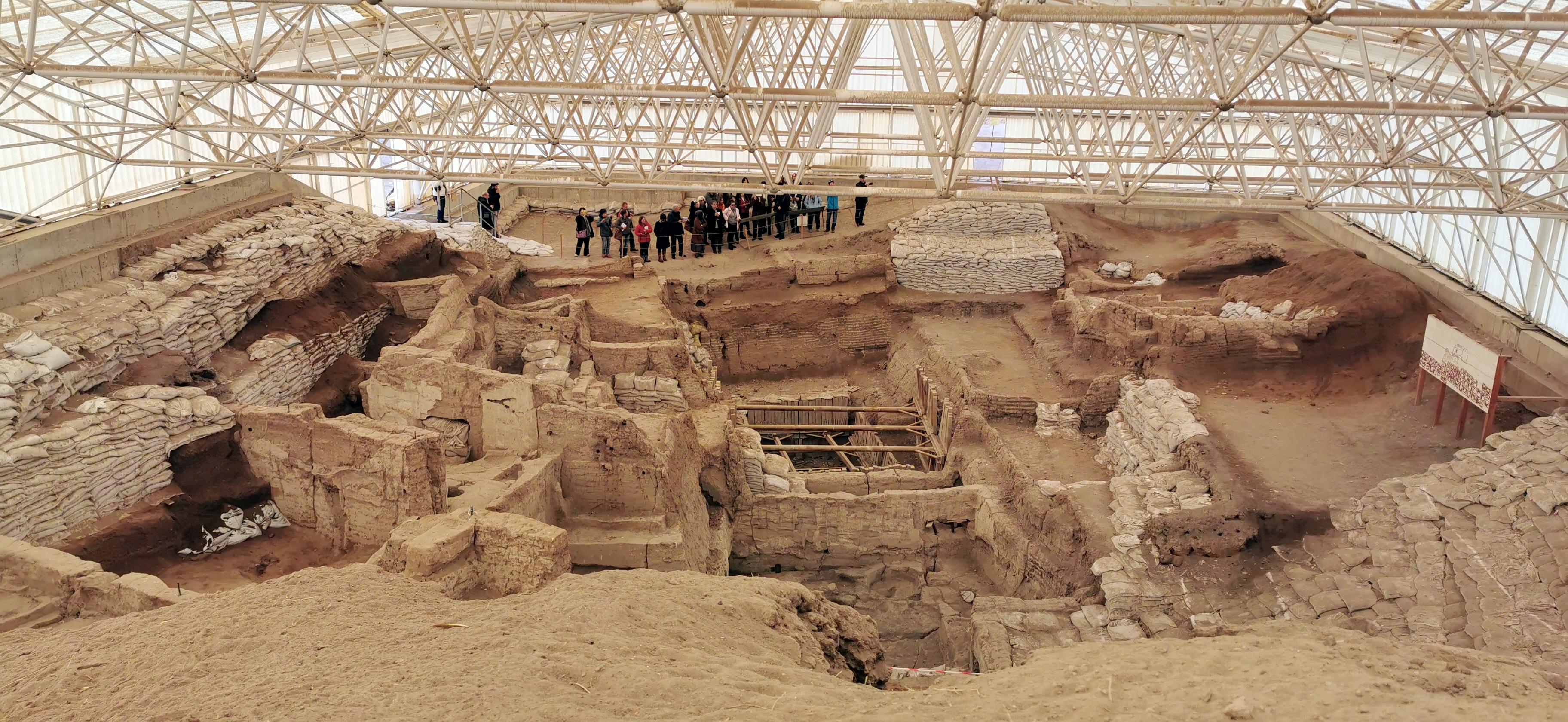
Çatalhöyük
One of the earliest and largest Neolithic settlements ever found, a proto-city that housed between 3,500 and 8,000 people from approximately 7500 to 5700 BCE, containing wall paintings, plaster reliefs, and burial deposits that have transformed archaeological understanding of how human beings first learned to live together in complex communities.