How You Empty the Fourth Largest Lake in the World
The Soviet Union decided in the 1950s and 1960s to transform Central Asia into a major cotton-producing region. Cotton requires large amounts of water. The Aral Sea is fed by two rivers: the Amu Darya and the Syr Darya, which flow from the mountains of Tajikistan and Kyrgyzstan and have sustained the ecosystems of Central Asia for millennia. The Soviet irrigation programme diverted these rivers to feed an enormous network of canals serving the new cotton fields of Uzbekistan, Turkmenistan, and Kazakhstan.
The canals were not well engineered. Estimates suggest that between 25 and 75 percent of the water diverted for irrigation was lost through seepage and evaporation before it reached the fields. The inefficiency did not prompt any reconsideration of the project. The cotton quotas continued. The rivers continued to be diverted. And the Aral Sea, receiving a fraction of its historical inflow, began to shrink.
Soviet planners knew this would happen. Internal documents from the 1950s acknowledge that the sea would dry up. The decision was that cotton was more valuable than the lake. The fishing communities who depended on it, the 60,000 jobs, the broader ecological consequences: these were externalities in a calculation that prioritised a production target set in Moscow.
The Texture of the Disaster
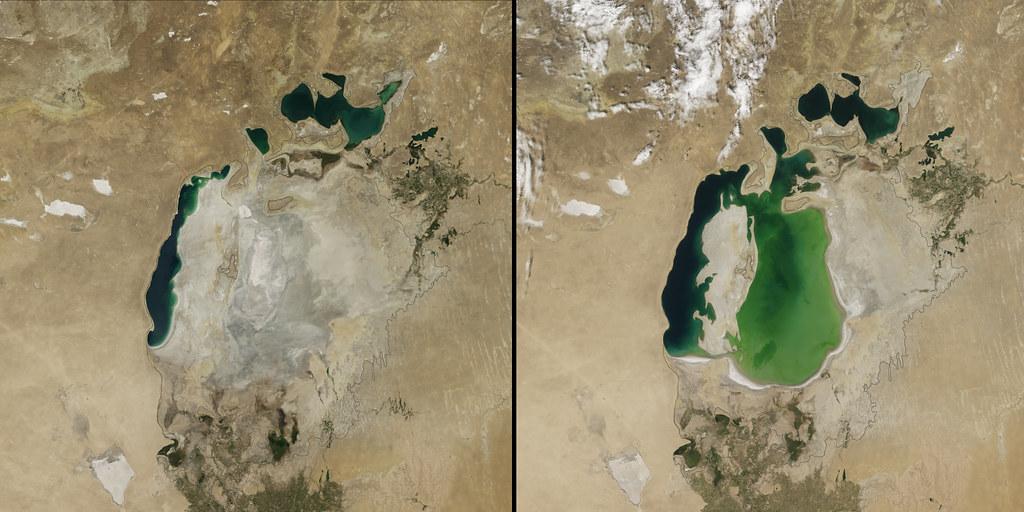
Numbers tell part of the story. The images tell a different part.
The ships are the most striking element for most people who have seen photographs of the Aral Sea. Rusting fishing trawlers and cargo vessels sitting on sand and scrub, their hulls corroded, their bridges empty, surrounded by nothing that resembles a sea. The town of Muynak in Uzbekistan was once a thriving port city with a waterfront. The water is now roughly 150 kilometres away. The ships in Muynak were not moved there as monuments. They are simply where they were when the water retreated past them and never came back.
The exposed lakebed is called the Aralkum, and it is one of the youngest deserts on earth. It is also one of the most toxic. Decades of Soviet-era agricultural runoff deposited pesticides, herbicides, and fertilisers in the lake water, which then concentrated as the water evaporated. The salt and chemical residue left on the lakebed is picked up by winds and carried across the surrounding region in dust storms that reach as far as the Himalayan glaciers and the Arctic. Studies have found Aral Sea dust in blood samples of people living in the region. Rates of anaemia, kidney disease, respiratory illness, and certain cancers in the communities around the former sea are among the highest documented anywhere in the world.
The cotton that justified all of this is still being grown. Uzbekistan remains a major cotton producer. The labour conditions in the cotton harvest have themselves been the subject of international human rights criticism. The commodity that justified the sacrifice of an entire inland sea continues to be produced in the landscape of its consequences.
The Northern Sea Comes Back
The story is not entirely without a different chapter, though it applies only to part of the sea.
Kazakhstan, which borders the northern portion of the Aral Sea, the Small Aral, undertook a project with World Bank funding to build a dam separating the northern and southern basins. The Kok-Aral Dam was completed in 2005. By preventing water from draining southward into the larger southern basin, it allowed the northern section to begin refilling from the Syr Darya. The results were faster than anyone had predicted. The northern sea rose significantly in its first years. Fish returned. A small-scale fishing industry restarted. The town of Aralsk, which had been a landlocked former port city for decades, saw the water return to within about 20 kilometres.
The southern basin, on the Uzbek side, received no equivalent intervention. It continued to shrink. The Uzbek government has largely accepted the loss of the southern sea and is attempting to manage the Aralkum as a new landscape, planting drought-resistant vegetation on parts of the exposed lakebed to reduce dust storm intensity. Whether this constitutes environmental management or simply the administration of a permanent catastrophe is a question that depends on your expectations.
What Heritage Means Here
This is the part of the Aral Sea story that does not get enough attention. What does it mean when an environmental disaster reaches the point at which it becomes, for the people who lived through it, a historical reality rather than an ongoing crisis?
The rusting ships in Muynak have become tourist attractions. Visitors travel to photograph them. There are guest houses. There is a small museum. The ships themselves, which represent the destruction of livelihoods and the death of an ecosystem, have acquired a kind of aesthetic resonance that makes them compelling to look at in the same way that ruins are compelling to look at. They are ruins. They are just very recent ones.
The former fishing communities carry a different kind of memory. For people who worked on the water, who grew up in port towns, who built their lives around an industry that the sea sustained, the shrinking of the Aral Sea was not a distant environmental event but a lived experience of loss that unfolded over decades. Their children grew up in places that used to be waterfront cities. Their grandchildren have never seen the lake that shaped everything their grandparents knew.
This is heritage in an unusual sense: not the preservation of something beautiful or historically significant in the conventional way, but the documentation and acknowledgement of a loss that was preventable, that was chosen, and that the communities who suffered it did not choose. The Soviet planners who diverted the rivers are dead. The bureaucratic structures that made the decision are gone. What remains are the ships in the sand, the dust in the blood samples, and the people who remember what the water looked like.
The Lesson That Has Not Been Learned
The Aral Sea is the most dramatic example in modern history of human activity destroying a major body of water. It is not unique in kind. Lake Chad in West Africa has shrunk by approximately 90 percent since the 1960s, driven by a combination of climate change and agricultural water extraction. The Dead Sea is dropping by over a metre per year. The Great Salt Lake in Utah reached its lowest recorded level in 2022 and carries its own accumulating ecological and public health consequences.
The Aral Sea disaster is documented, studied, taught in environmental science courses, and cited in policy discussions. It has not prevented the same pattern from recurring elsewhere. The specific failure that produced it, the subordination of ecological systems to short-term economic production targets without accounting for the consequences, is not a Soviet-era problem. It is a present-tense one.
What the Aral Sea offers, beyond its extraordinary and terrible landscape, is the most complete example available of what happens when that failure runs its full course. The lake took about 50 years to effectively disappear. The people who depended on it lost their industry, their health, and in some cases their communities within the span of a working life. The ecosystem that took thousands of years to develop was functionally destroyed in half a century.
That is what a disaster looks like when you can see the whole thing. Most of the time we are still inside ours, and we cannot see the edges yet.
Sources drawn from Philip Micklin's extensive research on the Aral Sea crisis, World Bank documentation on the Kok-Aral Dam project, UNEP environmental assessments of the Aralkum region, and public health studies on disease rates in former Aral Sea communities.