What Actually Happened on 10 April 1815
The eruption of Mount Tambora was not a surprise in the way that some volcanic events are. The mountain had been rumbling since 1812, and there had been smaller eruptions in the lead-up to the main event. But nothing prepared the region for what happened on the evening of 10 April.
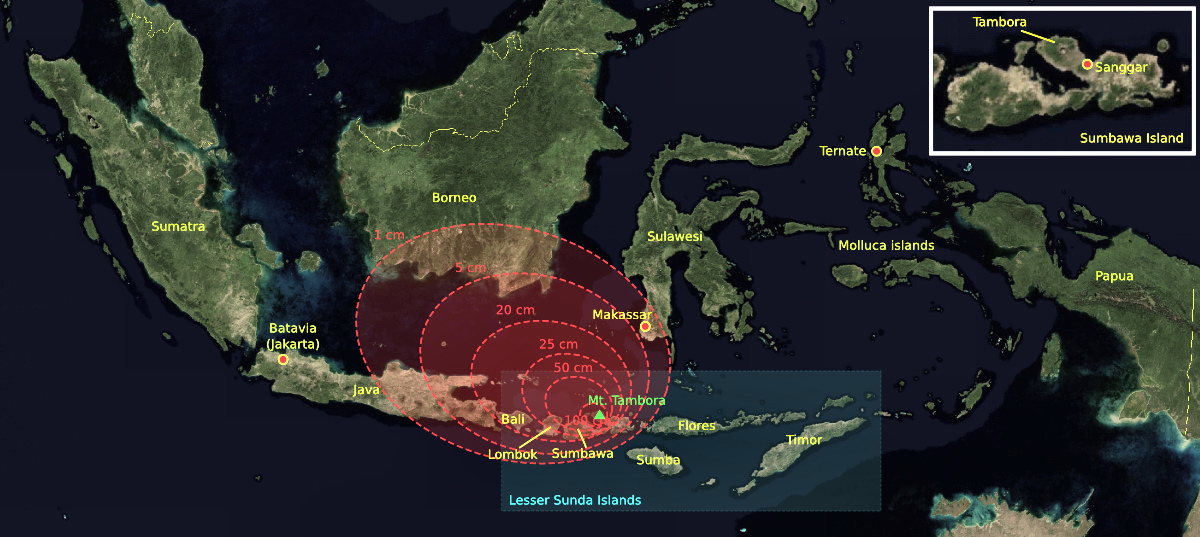
The explosion was heard 2,600 kilometres away in Sumatra. Ash fell as far as Borneo and Java. The eruption column reached approximately 43 kilometres into the atmosphere. In the Volcanic Explosivity Index, the scale used to measure eruptions, Tambora scores a 7 out of 8, making it by far the largest eruption since the Hatepe eruption in New Zealand around 180 CE.
The immediate destruction was catastrophic. The eruption killed an estimated 10,000 people directly, through the eruption column collapse and the pyroclastic flows that swept down the mountain's flanks. The tsunamis triggered by the eruption killed thousands more across the region. Ash fall destroyed crops across a wide area and contaminated water sources. The Kingdom of Tambora and the Kingdom of Pekat, both located on the mountain's slopes, were entirely wiped out. The Tamboran people, their language, their culture, their recorded history: gone. A whole civilisation erased in a single evening.
The Year Without a Summer
The immediate death toll was terrible. What happened next was, in terms of its global reach, even more significant.
The eruption injected an estimated 60 million tonnes of sulfur dioxide into the stratosphere. Once there, the sulfur dioxide combined with water vapour to form sulfate aerosols, tiny particles that spread across the upper atmosphere and reflected incoming solar radiation back into space. The result was a measurable global temperature drop of about 0.4 to 0.7 degrees Celsius. That may not sound like much. Applied across the entire planetary climate system at a critical point in the growing season, it was catastrophic.
1816 became known as the Year Without a Summer. In New England and Canada, killing frosts occurred in June, July, and August. Crops that had already been planted were destroyed. Snow fell in New England in June. In Europe, the summer of 1816 was the coldest in recorded memory, with persistent rain, low temperatures, and repeated crop failures. The Rhine flooded. The harvest failed across Switzerland, France, and Germany. Famine prices for grain spread across the continent.
In China and India, monsoon patterns were disrupted. In Bengal, the altered climate contributed to conditions that may have helped trigger the first great cholera pandemic, which would eventually spread globally and kill millions. In Ireland, where famine conditions developed, mass emigration began the slow demographic transformation that would accelerate dramatically in the 1840s.
The Cultural Aftershocks
This is where the story becomes genuinely strange, because the Year Without a Summer left fingerprints on European culture that are still visible today.
In June 1816, a group of writers and intellectuals gathered at the Villa Diodati on the shore of Lake Geneva in Switzerland. The summer was cold, grey, and relentlessly wet, the kind of summer Tambora had produced across Europe. Unable to go outside, they entertained themselves by reading German ghost stories aloud and eventually challenged each other to write their own horror tales. The eighteen-year-old Mary Godwin, who would become Mary Shelley, began writing the story that would become Frankenstein. Lord Byron wrote a poem called Darkness, describing a world without sunlight in terms that read as prescient rather than fantastical given what the atmosphere above them was actually doing.
Tambora's volcanic aerosols produced extraordinary sunsets across the Northern Hemisphere for several years. The particles in the stratosphere scattered red and orange wavelengths of light, creating vivid, lurid, prolonged sunsets that were unlike anything observers had seen before. J.M.W. Turner, the British painter whose landscapes and skies became increasingly dramatic through the 1810s and 1820s, may have been painting exactly what he was seeing. Researchers have matched the specific orange and red tones of his post-1815 sunsets to the optical effects produced by stratospheric aerosol loading from volcanic eruptions.
The Year Without a Summer also contributed, indirectly, to the invention of the bicycle. The repeated harvest failures of 1816 and 1817 killed horses in enormous numbers, as hay and fodder prices became prohibitive for ordinary people. A German inventor named Karl Drais, looking for an alternative to horse transport, developed a human-powered running machine in 1817 that he called the Laufmaschine. It had two wheels, a seat, and no pedals. You propelled it by pushing with your feet. It was the direct ancestor of the modern bicycle. Drais's motivation was explicit: the death of horses from famine conditions created a need for another way to get around.
What Remained of Tambora
The mountain that produced all of this is still there, though considerably shorter than it was in 1815. Before the eruption, Tambora stood at approximately 4,300 metres. After it, the collapsed summit left a caldera 6 kilometres wide and 700 metres deep. The mountain now stands at about 2,850 metres. It lost over 1,400 metres of elevation in a single evening.
The archaeological record of the Kingdom of Tambora, buried under metres of ash, is only now beginning to be excavated. Researchers have described it as a Pompeii of the East: the ash that destroyed everything also preserved the physical remains of a culture that would otherwise be entirely lost. Wooden structures, cultural objects, human remains: all sealed under the eruption deposits of 1815. The civilisation that was erased may yet tell us something about who it was.
Why This Story Is Not Better Known
Tambora happened in 1815, before the telegraph, before photography, before the global news infrastructure that made Krakatoa famous in 1883. The immediate death toll occurred in a part of the world that European powers had limited presence in and limited interest in reporting accurately. The global effects, the famines, the cold summers, the crop failures, were experienced by millions of people but were not understood at the time as connected to a single event in Indonesia. The causal chain from a volcanic eruption in Sumbawa to a failed harvest in Switzerland to a group of writers stuck inside a lakeside villa writing ghost stories is not an obvious one, and it took scientific reconstruction of the historical record over the following two centuries to make it visible.
The largest volcanic eruption in recorded human history changed the climate of the planet, killed tens of thousands immediately, contributed to famines and pandemics that killed millions more, erased a civilisation, and left marks on European literature, painting, and technology that are still traceable today. It did all of this in 1815, and the world largely forgot it happened.
Now you know it did.
Sources drawn from Gillen D'Arcy Wood's Tambora: The Eruption That Changed the World (Princeton, 2014), volcanological assessments of the 1815 eruption's atmospheric and climatic effects, historical records of the Year Without a Summer across Europe and North America, and ongoing archaeological work at the Kingdom of Tambora excavation site.