The Wool That Started It All
Before the patterns, there is the material. Kashmiri shawls are made from pashm, the fine downy undercoat of the Changthangi goat, which lives at high altitudes in Ladakh. This is not ordinary wool. It is extraordinarily soft, lightweight, and warm in a way that no other natural fibre quite matches. Emperor Akbar, who ruled the Mughal Empire from 1556 to 1605, was reportedly so taken with it that he gave it a name: param naram, meaning "supremely soft." When one of the most powerful rulers in the world gives your fabric a personal nickname, you know it is something special.
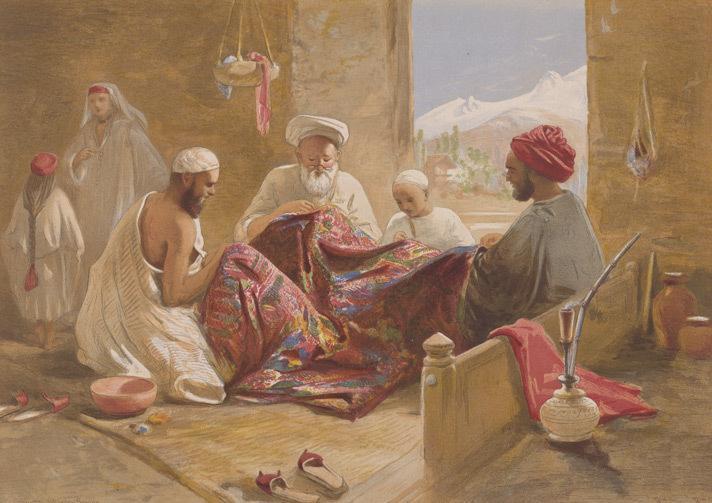
The most prized version of the shawl, called a Kani shawl, is woven using a double interlock twill technique that requires almost superhuman patience. A single intricate Kani shawl could take two skilled weavers three full years to complete. Three years. For one piece of cloth.
The Problem That Changed the Craft Forever
Here is where a practical problem produced something remarkable. If your finest product takes three years and two people to make, you cannot sell enough of them to keep an industry alive. In the 18th century, an artisan named Ali Baba came up with a solution that would transform Kashmiri textile production entirely.
He developed the Amlikar, an embroidered shawl where needle and thread reproduced the same intricate designs as the woven originals. The result looked almost identical to a Kani shawl. The production time dropped to roughly a quarter of what a comparable woven piece required. The craft survived because one person was creative enough to find a different way to achieve the same outcome.
That kind of adaptability runs through the whole history of the Kashmiri shawl. The industry was organised under Sultan Zain-ul-Abidin in the 15th century, who brought expert weavers from Turkestan to settle in Kashmir. It flourished under Mughal patronage. It expanded further under Maharaja Ranjit Singh in the early 19th century, whose consistent support helped turn Amritsar into a major hub for processing and exporting Pashmina. At every point, the craft survived because people found ways to keep it alive.
The Motifs: A Visual Language Worth Learning
The patterns on a Kashmiri shawl are not decorative in the way wallpaper is decorative. Each design, called a naqsh, carries meaning drawn from Persian poetry, Sufi philosophy, Islamic scripture, and the natural landscape of Kashmir itself. Once you know what you are looking at, a shawl becomes something closer to a text.
The Buta: The Shape the Whole World Borrowed
The Buta is the motif most people recognise, even if they do not know its name. In the West it became "paisley," named after the Scottish town that mass-produced it for European markets in the 19th century. In Kashmir it is known as badaam (almond) or ambi (mango), and it represents prosperity, fertility, and good fortune.
The origins of the shape are debated, but one compelling interpretation is that it represents the fusion of two symbols: a stylised floral spray and the Cypress tree. In Zoroastrian tradition the Cypress is a symbol of life and eternity. In Sufi thought it carries associations of modesty and quiet spiritual resistance, a tree that bends in the wind but does not break.
The earliest Kashmiri shawls featured simple floral motifs. By the late 18th century those flowers had evolved and accumulated detail until they became the complex, curving Buta that spread across borders and eventually became one of the most widely reproduced decorative patterns in the world. The shape that appears on countless mass-produced scarves today started in a Kashmiri weaving workshop centuries ago, carrying meanings that most people who wear it have never been told.
The Gulale: When a Flower Means Divine Love
The tulip, called Gulale in Kashmiri, is not simply a pretty flower to the people who wove it into shawls. In the Muslim garden tradition the tulip was considered the holiest of all flowers. When a tulip blooms fully, its head bends forward under the weight of the petals. That bowing posture was read as an act of modesty before God, the flower lowering itself in reverence before the Beloved.
Sufi poets used the tulip extensively in their writing to express Ishq Haqiqi, divine love, the longing of the human soul for union with the divine. When a weaver or embroiderer placed a tulip motif on a shawl, they were not just filling space with a pleasing shape. They were embedding a whole vocabulary of devotion and longing into the fabric itself.
The Daen Posh: What a Pomegranate Means to a Family
The Daen Posh, or Pomegranate Blossom, carries a different kind of weight. The pomegranate is mentioned in the Holy Quran and has long been associated in Islamic tradition with blessings, abundance, and divine generosity. A single pomegranate contains hundreds of seeds bound together under one skin, and that image of unity is not lost on the artisans who incorporate it into their work.
Craftspeople who have worked with this motif describe it as carrying a specific cultural message: that family members should remain closely bound to each other, like the seeds of a pomegranate. It is a domestic blessing worked into something that might be given as a gift, worn at a wedding, or passed down through generations.
The Boone Pan: Kashmir Written in Leaf Form
The Chinar tree, called Boone Pan in Kashmiri, is the state tree of Kashmir and one of the most recognisable features of the region's landscape. In autumn the Chinar turns extraordinary shades of red and gold, and its broad, maple-like leaves have become inseparable from Kashmiri visual identity.
Unlike the Buta or the Gulale, the Boone Pan is not drawn from Persian or Sufi tradition. It is directly local, a motif that says: this came from here, from this specific valley, from the trees that line these specific lakes and gardens. It appears across Kashmiri craft traditions, from woodwork to textile, because it is not a borrowed symbol but one that grew out of the landscape itself.
How a Kashmir Shawl Ended Up in European Portraits
For a long time, Kashmiri shawls were worn primarily by men of rank in India. They signified status and refinement, and were given as gifts between nobles and rulers. Then, somewhere in the late 18th century, the shawl crossed into Europe, and everything changed.
Napoleon's Egyptian campaign is often cited as the turning point. Officers returning from the Middle East brought the shawls back with them, and the fashion spread rapidly. European noblewomen began draping them over their shoulders, and painters began including them in portraits as markers of wealth and cosmopolitan sophistication. By the early 19th century, demand was so high that manufacturers in Paisley, Edinburgh, Lyon, and Vienna were producing their own versions.
That European appetite for Kashmiri design is how the Buta became "paisley," why the pattern appears on everything from luxury scarves to budget bedding today, and why a motif born in a Kashmiri workshop now shows up in virtually every corner of the world.
A Craft That Has Refused to Disappear
The Kashmiri shawl industry has faced serious pressures across its history: high taxation under colonial administration, competition from industrial European production, market disruptions of various kinds. It has not always been easy. But the craft has endured, in part because of the adaptability that has always defined it, from Ali Baba's embroidery innovation to the ways contemporary artisans continue to find markets for handmade work in a world full of machine-made alternatives.
What has also endured is the motif system. The Buta, the Gulale, the Daen Posh, the Boone Pan: these are not just decorative choices. They are a way of making visible a set of values, beliefs, and connections to place that have been passed down through generations of Kashmiri artisans. When you understand what the patterns mean, a shawl stops being a beautiful object and becomes something more like a conversation across centuries.
The next time you see that teardrop shape, you will know what it is actually saying.
Sources: This piece draws on scholarship by Bhat (2025) on symbolism in Pashmina shawl motifs, Carberry (2021) on the cultural significance of the Kashmiri shawl in the age of imperialism, Hart (2018) on the origins and dissemination of Kashmir shawls, Kaur (2024) on the industry under Maharaja Ranjit Singh, and Yaqoob et al. (2012) on traditional Kashmiri Pashmina production, among others.