
Heritage in Southeast Asia
Explore heritage sites and cultural practices from Southeast Asia.
Sites in this Region
Showing 3 documented sites

Angkor
The most extensive low-density urban complex of the pre-industrial world — a religious and administrative capital of the Khmer Empire that at its twelfth-century peak may have supported a population of up to one million people across an urban footprint of roughly 1,000 square kilometres. At its core stands Angkor Wat, the largest religious monument on earth, alongside hundreds of temples, reservoirs, hydraulic works, and urban infrastructure distributed across a landscape that has only recently been mapped to its full extent by aerial LiDAR survey. The hydraulic systems that sustained the city's population are simultaneously its greatest engineering achievement and the focus of its most urgent conservation science.

Shwedagon Pagoda
Shwedagon Pagoda (Shwedagon Zedi Daw — 'Glorious Shwedagon') is the most sacred Buddhist site in Myanmar and one of the most significant Buddhist monuments in the world: a 98-metre gilded stupa rising from Singuttara Hill above Yangon, surrounded by a vast terrace complex of smaller stupas, shrines, temples, and ritual spaces. The main stupa is plated with gold — donated by devotees across centuries — and its finial (hti) is encrusted with thousands of diamonds, rubies, sapphires, and other precious stones, topped with a 76-carat diamond. The pagoda is believed to enshrine eight hairs of the historical Buddha Gautama, as well as relics of the three preceding Buddhas of the current world cycle, making it one of the most sacred relic sites in Theravada Buddhism. It is not merely a monument but a living religious site, continuously active as a place of daily worship, donation, and ritual observance by the Buddhist population of Myanmar.
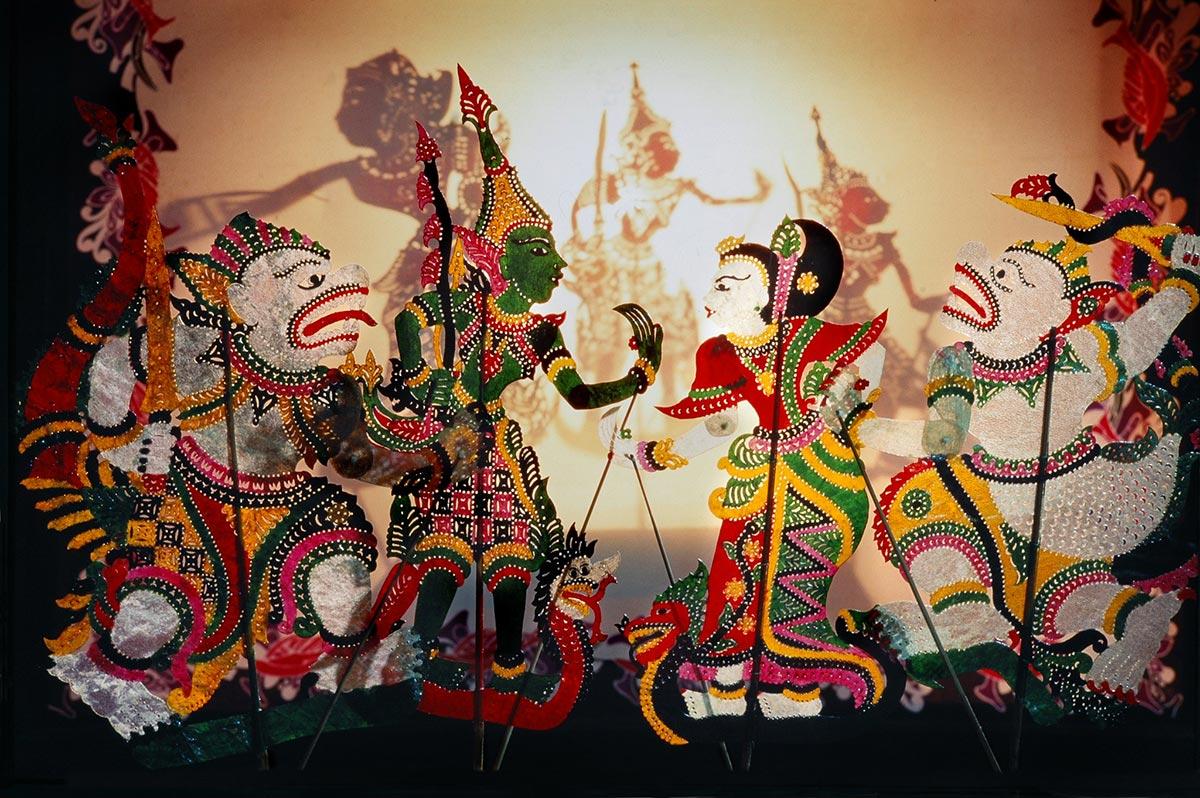
Wayang Kulit
Intricate leather shadow puppetry accompanied by gamelan orchestras, serving as moral instruction, spiritual ritual, and social commentary.