
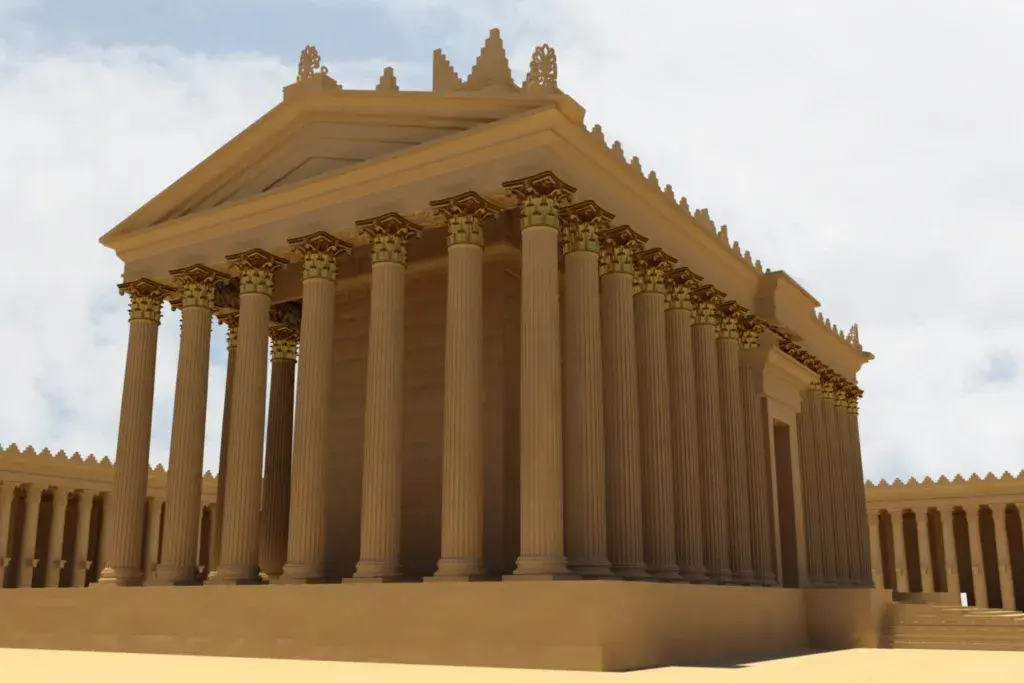
Resurrecting the Pearl of the Desert
The ancient city of Palmyra, isolated in the Syrian desert, was once a wealthy oasis metropolis bridging the Roman and Parthian empires. Its architecture was a unique, spectacular fusion of Greco-Roman techniques with local traditions and Persian influences. For centuries, its monumental ruins stood as a testament to the endurance of human cultural synthesis.
In 2015, that physical endurance was shattered. During the Syrian Civil War, the Islamic State (ISIS) captured Palmyra and deliberately detonated explosives inside several of its most significant structures, including the monumental Temple of Bel, the Temple of Baalshamin, and the iconic Monumental Arch.
The physical stones were reduced to rubble. But the memory of Palmyra—captured in millions of photographs, 3D scans, and archival drawings over the preceding two centuries—remained intact. This article explores how a global consortium of researchers, archaeologists, and technologists are utilizing cutting-edge digital tools to reconstruct Palmyra in virtual space, and the complex ethical debates this resurrection provokes.
The Architecture of Destruction
The destruction of Palmyra was not collateral damage in a crossfire; it was a highly orchestrated, performative act of "cultural cleansing." The erasure of physical heritage is a documented tactic used to demoralize populations, eradicate historical identities that contradict a fundamentalist narrative, and generate shocking propaganda to recruit global followers.
When Syrian forces, backed by Russian airstrikes, recaptured the site in 2016, the devastation was profound. The cella (inner sanctuary) of the Temple of Bel, a massive structure dedicated to the Semitic god Bel in 32 CE, was entirely leveled. Only the towering entrance portal remained precariously standing amidst a sea of shattered, massive limestone blocks.
The Digital Assembly Line
To rebuild what was lost, researchers could not rely on physical restoration in an active conflict zone. Instead, they turned to the digital realm, launching an massive crowdsourcing initiative to collect every scrap of visual data regarding the destroyed monuments.
1. The Database of Memory
Project groups like the Institute for Digital Archaeology (IDA) and New Palmyra launched online portals urging tourists, researchers, and military personnel to upload any photographs they had ever taken of the site.
The response was overwhelming. Millions of images—from blurry, low-resolution vacation snapshots taken in 2004 to high-definition professional architectural surveys from 2010—flooded the servers.
2. Algorithmic Photogrammetry
The core technology driving the reconstruction is photogrammetry. In basic terms, photogrammetry software analyzes hundreds or thousands of overlapping 2D photographs of an object from different angles. By identifying common points (pixels) across multiple images, the algorithm can calculate the exact camera position and triangulate the distance to those points, generating a dense, three-dimensional "point cloud."
When applied to Palmyra, the challenge was immense. The dataset was totally unstructured. Images were taken at different times of day, with different lighting, using wildly different cameras and lenses, and from completely random angles.
Advanced algorithms, some utilizing deep learning techniques to estimate depth from single images, were deployed to filter and align this chaotic dataset.
"We are relying on the collective memory of the world to rebuild the past. Every tourist snapshot is a brick; the algorithms are simply the mortar holding them together." — Project Lead, Digital Heritage Consortium.
3. Filling the Gaps with Archival Data
Where photographic coverage was incomplete, particularly for roofs or obscured angles, researchers turned to historical archives. They digitized and algorithmically matched 19th-century sketches by early explorers, precise architectural drawings from mid-20th-century French archaeological expeditions, and satellite imagery.
The result is a highly detailed, textured 3D model of the Temple of Bel and the Monumental Arch, accurate down to millimeter-scale weathering patterns and individual chisel marks visible right before their destruction.
The Ethics of the Virtual Replica
The technological triumph of digital reconstruction immediately birthed intense ethical and philosophical debates regarding authenticity, ownership, and the purpose of heritage.
The Illusion of Completeness
Critics argue that highly polished, immersive digital or physical replicas (like the 3D-printed, two-thirds scale model of the Palmyra Arch erected in Trafalgar Square and Times Square) prioritize a pristine aesthetic over historical reality.
By seamlessly resurrecting the monument in a digital utopia, we risk erasing the memory of the trauma it suffered. Does a perfect digital replica sanitize the brutal violence of the Syrian war? Should a digital model represent the Temple of Bel as it stood in 2010, or as the pile of rubble it is today?
"A ruin is a document of time. When we fill the gaps with algorithms, we stop reading the document and start writing fiction." — Dr. Elena Rossi, Conservation Theorist.
Digital Colonialism
Furthermore, there is a fierce debate over data sovereignty. The digital models of Palmyra are largely housed on servers in European and American universities or private tech companies. While the physical ruins remain in Syria, the pristine digital avatars—and the intellectual property surrounding them—are controlled by the West.
Syrian scholars and refugees argue that they must have primary agency in determining how, when, and if these digital models are used, displayed, or monetized. The reconstruction of their heritage cannot be dictated by the very nations that historically colonized the region or intervened in the conflict.
Conclusion: A New Paradigm for Heritage
The digital reconstruction of Palmyra represents a chaotic, brilliant, and deeply flawed turning point in heritage conservation. It proves that while explosives can destroy physical stone, they cannot easily destroy the distributed, global data representing that stone.
Yet, it also warns us that a 3D model is not a building. It lacks the context, the smell of the desert, the scale, and the tragic history of the original. Digital preservation is an incredibly powerful tool for documentation and education, but it is a supplement to, not a replacement for, the complex, messy, and crucial work of physical conservation in the real world.
