
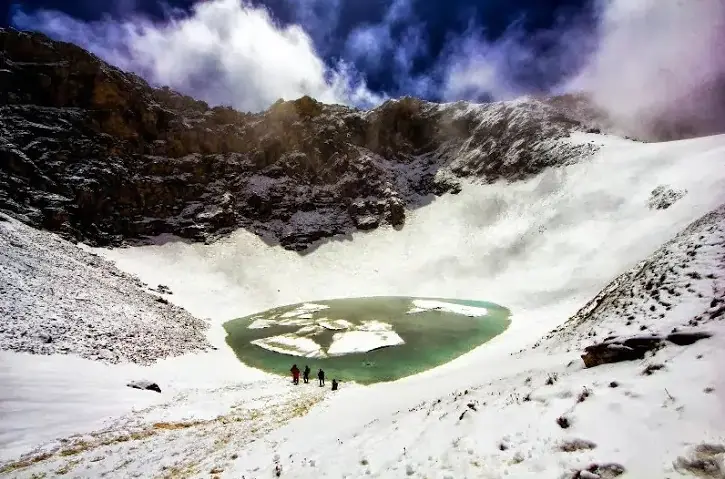
Roopkund Lake
Interactive 3D Scan
Explore 3D Model
Click to load interactive scan
ROOPKUND LAKE Chamoli District, Uttarakhand, India · c. 800 CE to c. 1800 CE · Multi-event mass death site CRITICALLY ENDANGERED
SITE AT A GLANCE Location: Chamoli District, Uttarakhand, India, at 5,029 metres elevation in the Garhwal Himalayas Country: India Region: South Asia / Himalaya Coordinates: 30.2480° N, 79.7326° E Type: Natural Heritage / Archaeological Site Sub-types: Archaeological Sites, Sacred Geographies Period: Skeletal remains dated c. 800 CE to c. 1800 CE across multiple events; Nanda Devi Raj Jat pilgrimage route ancient Risk Level: Critically Endangered Risks: Trekker removal of remains, Glacial melt exposure, No legal protection, Meltwater dispersal, No site management, No 3D documentation baseline UNESCO Status: Adjacent to Nanda Devi and Valley of Flowers National Parks (inscribed 1988); Roopkund itself not inscribed
3D DOCUMENTATION Roopkund Lake has never been systematically documented in three dimensions. No Sketchfab model exists. This is the most significant documentation gap in this collection: a site of extraordinary scientific importance has no geometric baseline against which the progressive loss of its skeletal remains can be measured. Open Context at opencontext.org hosts the South Asian Archaeological Open Data Repository, which includes data from Uttarakhand sites. The Archaeological Survey of India's Uttarakhand heritage register is accessible at asi.nic.in. The definitive scientific work on the site — Harney et al. (2019), Ancient DNA from Roopkund Lake skeletons — is available in full open access via Nature Communications. Harney et al. (2019) — open access: https://www.nature.com/articles/s41467-019-11357-9 Open Context — South Asian Archaeological Data: https://opencontext.org/ Archaeological Survey of India: https://asi.nic.in/ UNESCO — Nanda Devi and Valley of Flowers: https://whc.unesco.org/en/list/335
SITE DESCRIPTION Roopkund is a glacial lake approximately 40 metres in diameter, set in a glacial cirque at 5,029 metres elevation in the Garhwal Himalayas of Uttarakhand, India. For most of the year it is frozen. When it melts in summer, the bones of approximately 800 individuals appear — on the lake bed and scattered on the surrounding slopes, washed by meltwater, bleached by altitude ultraviolet radiation, exposed by the retreat of glacial ice that once protected them, and periodically picked up by trekkers who take them as souvenirs. Flesh has been preserved on some specimens by the cold. Hair and nails survive on others. The lake is at times translucent enough to see bones on its floor. The surrounding landscape is extraordinary: the mountain Trishul (7,120 metres) dominates the view, and the route to Roopkund passes through the Bedni Bugyal meadows, one of the most beautiful high-altitude grasslands in the Himalayas. The site lies on the Nanda Devi Raj Jat pilgrimage route — a sacred path through the high Himalayan valleys that is walked every twelve years by pilgrims from across the Garhwal region. The lake has never been systematically documented in three dimensions. Nobody has produced a baseline geometric record of the site. This means that the loss of remains — which researchers document visually on each visit — cannot be quantitatively tracked.
HISTORICAL SIGNIFICANCE The dead at Roopkund represent not one catastrophic event but multiple events across at least a thousand years. The 2019 ancient DNA study — the most comprehensive scientific work on the site — analysed 38 individuals and identified three genetically distinct groups: The South Asian group is the largest, dated to approximately 800 to 1000 CE and separately to 1700 to 1900 CE, suggesting at least two separate events involving individuals from within or near the Himalayan region. The pilgrimage hypothesis — that these are people who died on or near the Nanda Devi Raj Jat route — is plausible for at least some of them. The Eastern Mediterranean group consists of 14 individuals whose genetic ancestry is most consistent with modern populations from Crete and the Greek islands. They are dated to approximately 1700 to 1800 CE — not ancient, not medieval, but 18th century — and their genetic profiles suggest they came from the same community rather than being unrelated individuals. Fourteen people from Crete or the Greek islands at a remote Himalayan lake at 5,029 metres elevation in the 18th century, all dying in what appears to have been a single event, is an observation for which no agreed explanation exists. The Southeast Asian group is small and less well-characterised. Their dating and the circumstances of their deaths are less clear. The diversity of population groups, separated by centuries, confirms that Roopkund is not a single-event tragedy but a site that has received the bodies of multiple separate groups across a millennium.
THE STORY OF THE SITE
c. 800 to 1000 CE: The First Event The earliest South Asian group dies at Roopkund in circumstances that the current evidence does not fully resolve. The Nanda Devi Raj Jat pilgrimage route passes through this landscape, and the ancient Indian text Kedarnath Mahatmya contains a reference to pilgrims killed by hailstones as hard as iron in a mountain valley. Skeletal analysis of some Roopkund individuals shows fractures on the skulls consistent with blunt force trauma from above — consistent with a severe hailstorm striking an exposed group on open ground.
c. 1700 to 1800 CE: The Mediterranean Event Fourteen individuals of Eastern Mediterranean genetic ancestry — most likely from Crete or the Greek islands — are at Roopkund at some point in the 18th century and die there. The theories proposed to explain their presence include Greek mercenaries serving an Indian ruler, Levantine traders on an unusual commercial route, Eastern Orthodox Christian pilgrims accompanying Hindu pilgrims, and unknown diplomatic or military missions of the Mughal or post-Mughal period. None of these explanations is supported by documentary evidence. None has achieved scholarly consensus.
c. 1700 to 1900 CE: Later South Asian Events A second, later group of South Asian individuals also dies at Roopkund in what appears to be a separate event from the 9th to 10th century deaths. The cause and circumstances of this later event are also unresolved.
1942: The British Discovery A British forest ranger, Hari Kishan Madhwal, encounters the skeletal remains during World War II and reports them to authorities. The British initial theory — that the bones are Japanese soldiers who died attempting to invade India through the Himalayas — is quickly disproved by skeletal analysis and artefact examination. What the remains actually represent is, at this point, entirely unknown.
2004: The National Geographic Expedition A National Geographic expedition conducts DNA analysis and radiocarbon dating, suggesting a 9th-century event and a death mechanism consistent with a severe hailstorm. The hailstorm hypothesis is adopted by most popular accounts of the site.
2019: The Harvard Ancient DNA Study A team led by Eadaoin Harney and David Reich at Harvard, working with the CSIR-Centre for Cellular and Molecular Biology in Hyderabad and researchers from multiple international institutions, publishes the ancient DNA study that reveals the true complexity of the site. The three distinct population groups, the multiple centuries of events, and most dramatically the 14 Eastern Mediterranean individuals produce results that generate global scientific attention and no agreed explanations. The paper is published in Nature Communications in full open access.
Present: Ongoing Destruction Climate change is accelerating the melting of the ice that has protected some of the remains. Trekkers continue to remove bones. Meltwater continues to disperse skeletal elements from their original deposit contexts. Each year, the available sample of analysable remains decreases. The site has no legal protection framework specifically covering the skeletal material. There is no site management at 5,029 metres. There is no 3D documentation baseline.
THREATS AND RISK ASSESSMENT Trekker Removal The skeletal remains at Roopkund have been removed by trekkers for decades — taken as souvenirs, as curios, as photographs rather than bones. Remains from Roopkund have been found in private collections internationally. This removal is not malicious in most cases; it is the consequence of a high-altitude trekking destination whose extraordinary story attracts people who, lacking any information about why the bones matter scientifically, treat them as landscape features rather than irreplaceable archaeological evidence. A simple information and interpretation infrastructure at the site would address most of this problem. That infrastructure does not exist.
Climate Change and Glacial Melt The retreat of the glacial ice surrounding and over parts of the lake bed is exposing remains that were previously protected by burial under ice. This is, paradoxically, both an opportunity — new material becoming available for analysis — and a threat, because newly exposed remains are subject to immediate mechanical erosion, meltwater transport, and UV damage at altitude. The window between exposure and destruction is narrow and is not being systematically exploited by research teams.
No Legal Protection India's archaeological protection legislation does not clearly cover high-altitude skeletal remains in the circumstances of Roopkund. The site falls within the Nanda Devi Biosphere Reserve, which is managed primarily as a natural heritage area. Advocacy for formal archaeological protection status has been undertaken by researchers but has not yet resulted in legislative action.
RESEARCH AND SCHOLARLY CONTEXT The definitive scientific work is Harney et al. (2019), published in Nature Communications in full open access. The study analysed 38 individuals from a site estimated to contain approximately 800 — meaning the vast majority of the population at Roopkund remains unstudied. The ancient DNA available from the site, the stable isotope data that could illuminate diet and geographic origin, and the physical anthropological data that could resolve questions of trauma and cause of death represent an extraordinary research resource that is being actively destroyed by the combination of trekker removal, meltwater dispersal, and glacial exposure. The Max Planck Institute for Evolutionary Anthropology published supporting analyses of the Roopkund material. Open Context's South Asian Archaeological Open Data Repository hosts data from related Uttarakhand sites. The UNESCO World Heritage dossier for Nanda Devi and Valley of Flowers National Parks covers the protected landscape in which Roopkund sits, though the lake itself is outside the strictly protected zones.
IF NOTHING CHANGES The skeletal remains at Roopkund are disappearing. Not dramatically, not in the way that a flood or a landslide destroys a site, but steadily: a bone removed here, a femur washed into the lake there, a skull dispersed downslope by meltwater, a new section of ice melting to expose material that will have been eroded within a season. The 2019 study analysed 38 individuals from a site containing approximately 800. That ratio represents the current state of the evidence — the small fraction of what was once a complete assemblage. Each year, the fraction shrinks. What makes this loss particularly costly is that the tools available to analyse what remains are more powerful than at any previous moment: ancient DNA, stable isotope analysis, high-resolution imaging, computational facial reconstruction from skeletal morphology. The 14 Eastern Mediterranean individuals at Roopkund are one of the most compelling unsolved archaeological mysteries of the 21st century, and the evidence needed to solve it is lying on a lake bed at 5,029 metres, being slowly removed by trekkers and washed away by meltwater. The question of who those people were, and what they were doing at a remote Himalayan lake in the 18th century, is one that the remaining skeletal material could answer, if it can be protected long enough to be studied.
Knowledge Vault
Harney et al. (2019) — Ancient DNA from Roopkund Lake skeletons (Nature Communications, open access)
Max Planck Institute — Roopkund Biomolecular Analysis Press Release
Archaeological Survey of India — Uttarakhand Heritage Register
Open Context — South Asian Archaeological Open Data Repository
UNESCO World Heritage — Nanda Devi and Valley of Flowers National Parks
Screening Room

Roopkund: India's Skeleton Lake Mystery
Historical Timeline
First South Asian Event
The earliest South Asian group dies at Roopkund. Skull fractures suggest a severe hailstorm on exposed open ground.
The Mediterranean Event
14 individuals of Eastern Mediterranean genetic ancestry die at Roopkund in what appears to be a single event. No explanation has achieved scholarly consensus.
Later South Asian Events
A second, later South Asian group also dies at Roopkund in a separate event from the earliest deaths.
British Discovery
Forest ranger Hari Kishan Madhwal reports the remains. The initial theory of Japanese soldiers is quickly disproved.
National Geographic Expedition
DNA analysis and radiocarbon dating suggest a 9th-century hailstorm event.
Harvard Ancient DNA Study
Harney et al. reveal three distinct population groups including 14 Eastern Mediterranean individuals — generating global attention and no agreed explanations.
Ongoing Destruction
Trekker removal, meltwater dispersal, and glacial exposure are steadily reducing the available skeletal assemblage.
Quick Facts
Location
Chamoli District, Uttarakhand, India, in the Himalayan high-altitude zone
Country
India
Region
South Asia / Himalaya
Period
Skeletal remains dated c. 800 CE to c. 1800 CE across multiple separate events; site lies on the ancient Nanda Devi Raj Jat pilgrimage route
Type
Natural Heritage
Risk Level
Critically Endangered