
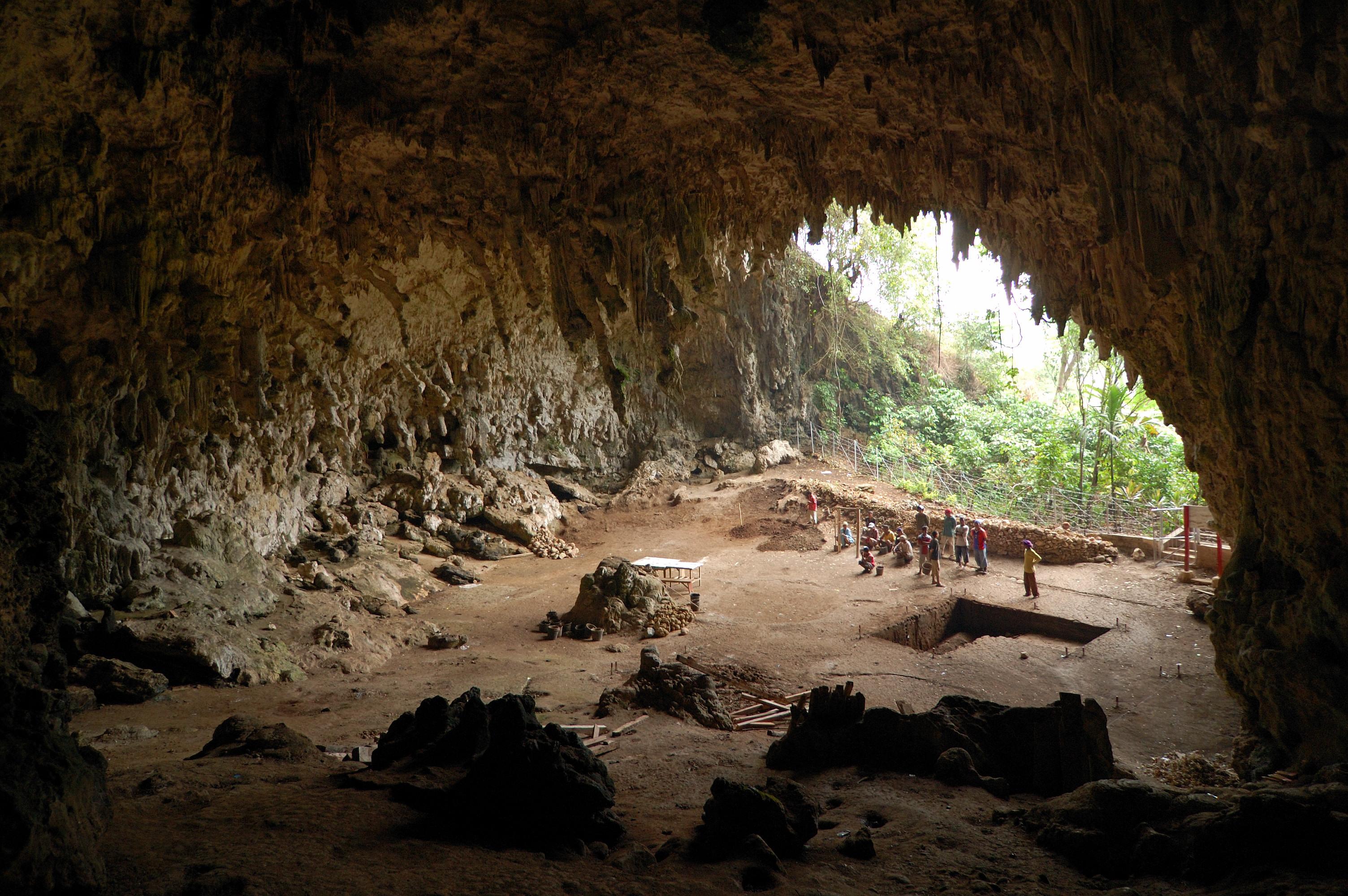
Liang Bua Cave
Liang Bua Cave
Site Description
Liang Bua is a large limestone cave on the island of Flores in eastern Indonesia, approximately 14 metres high at the entrance and 40 metres deep, carved by water action through the karst limestone of the hillside over an extended geological period. The cave has a cool, relatively stable internal microclimate and has historically provided shelter for both human and non-human occupants. What makes it one of the most significant archaeological sites in the world is what was found in its sediment layers when a Dutch-Indonesian team began systematic excavation in 2001: the skeletal remains of a previously unknown species of hominin, Homo floresiensis, whose existence had not been suspected and whose implications for understanding human evolution in island Southeast Asia continue to be debated and investigated.
The cave's sediment sequence spans hundreds of thousands of years, with the deepest deposits dating to around 190,000 years before present. Within this sequence, the remains of Homo floresiensis — the so-called Hobbit — appear from at least 100,000 years ago and persist until approximately 50,000 years ago, when they disappear from the record, possibly coinciding with the arrival of anatomically modern humans in the region. The floresiensis individuals were small, with adult stature of approximately one metre, and had brain volumes significantly smaller than modern humans. They made stone tools, hunted pygmy elephants, and lived on an island whose isolation had produced a distinctive fauna of dwarfed and gigantic animals through the evolutionary processes characteristic of island environments.
Historical Significance
The discovery of Homo floresiensis in 2004 was one of the most significant palaeoanthropological findings of the twenty-first century. The existence of a small-bodied, small-brained hominin living on Flores until as recently as 50,000 years ago, overlapping in time with anatomically modern humans, challenges the model of human evolution as a story of progressive replacement in which archaic hominins were sequentially displaced by more cognitively advanced successors.
The debate about the nature of floresiensis — whether it represents a dwarfed descendant of Homo erectus, an early dispersal of a more primitive hominin from Africa, or an entirely separate lineage — has generated an enormous research literature and has not been fully resolved. The implications for understanding the diversity of hominin species that coexisted with anatomically modern humans in the late Pleistocene, and for the routes and timing of human dispersal through Southeast Asia and into Australasia, are significant regardless of which interpretation ultimately prevails.
The cave is also significant as a site of continuous local cultural significance to the people of Flores, for whom it has been a place of gathering, ceremony, and community life across historical memory.
Threats and Risk Assessment
Flooding and Sediment Disturbance
Liang Bua's sediment sequence, which is the primary research resource of the site, is vulnerable to the seasonal flooding that affects the cave during the Indonesian wet season. Water entering the cave through the entrance and through the karst drainage system can disturb stratigraphic contexts and damage fragile skeletal material in both excavated and unexcavated areas.
Humidity and Biological Decay
The cave's naturally high humidity creates conditions that promote the biological decay of organic materials and the chemical alteration of bone and other skeletal elements. The conservation of excavated material and the protection of unexcavated deposits from accelerated decay requires sustained attention to the cave's microclimate.
Visitor Management
The cave's fame since the 2004 discovery has brought a significant increase in visitor interest. Managing visitor access in a way that protects the fragile sediment sequence and the unexcavated deposits that still contain significant research material requires infrastructure and enforcement capacity that is not always available.
Institutional Capacity
Research at Liang Bua is dependent on international collaboration and external funding, and the continuity of the research programme is subject to the fluctuations in funding availability that affect all international archaeological research.
Research and Scholarly Context
The research at Liang Bua has generated an extraordinarily productive debate within palaeoanthropology. The identification of floresiensis remains at Mata Menge on Flores, dating to approximately 700,000 years ago and representing individuals even smaller than the Liang Bua floresiensis, has extended the known history of the lineage and strengthened the evolutionary interpretation of the Liang Bua remains.
Research into the cognitive capabilities of floresiensis, inferred from the stone tool assemblages and the evidence of cooperative hunting of Stegodon, has contributed to broader debates about the relationship between brain size and cognitive complexity in hominin evolution. The methodological standards of the ongoing excavation have produced a chronological framework for the site's deposits that is among the most thoroughly established in Southeast Asian prehistoric archaeology.
If Nothing Changes
Liang Bua's unexcavated deposits still contain skeletal and archaeological material whose recovery would significantly advance understanding of Homo floresiensis and of the hominin history of island Southeast Asia. The risk is not of sudden dramatic loss but of the gradual deterioration of deposit integrity through seasonal flooding, biological processes, and visitor impact, and of the research discontinuities that result from funding uncertainty in international collaborative projects.
Liang Bua is where the human family tree gained an unexpected new branch, and the implications of that discovery for understanding what it means to be human are still being worked out. Protecting the site and sustaining the research programme that investigates it is an investment in one of the most significant scientific questions of our time.
Historical Timeline
The Earliest Cave Occupants
The oldest deposits in Liang Bua's sediment sequence date to approximately 190,000 years before present, and contain stone tools associated with the presence of hominins in the cave. Whether these earliest occupants are Homo floresiensis or an earlier hominin population is not yet established, but their presence confirms that the cave has been a focus of hominin activity for an extraordinary length of time.
Homo floresiensis
The skeletal remains of Homo floresiensis are found in deposits dating from at least 100,000 to approximately 50,000 years before present. During this period, the floresiensis individuals are living in and around the cave, making stone tools, hunting the pygmy Stegodon elephants that inhabit the island, and leaving the archaeological traces that will eventually make Liang Bua famous.
The Disappearance
The Homo floresiensis remains disappear from the Liang Bua sequence around 50,000 years ago, after which the deposits contain evidence of anatomically modern human occupation. Whether modern human arrival caused the extinction of floresiensis through direct competition, disease, or habitat modification, or whether floresiensis disappeared for other reasons around the same time, is not established by the current evidence.
Continuous Local Use
The cave continues to be used by local communities through the historical period and into the present, serving as a gathering place and site of cultural significance for the people of the Liang Bua area. This continuous human use means that the cave's upper sediment layers contain a mixture of recent and archaeological material that requires careful excavation to interpret.
Discovery and Announcement
A Dutch-Indonesian research team begins systematic excavation of Liang Bua in 2001. In 2003, the excavation recovers the first skeletal remains of Homo floresiensis from deposits approximately six metres below the surface. The announcement of the discovery in 2004, published in Nature, generates extraordinary global media attention and immediate scientific controversy.
Debate, Reanalysis, and Continued Excavation
The discovery generates a substantial and sometimes heated scientific debate, with a minority of researchers arguing that the remains represent pathological modern humans rather than a separate species, and the majority maintaining the species interpretation. Subsequent analysis and the identification of floresiensis remains at Mata Menge dating to approximately 700,000 years ago have strengthened the species interpretation considerably, though the debate has not been entirely closed.
Quick Facts
Location
Liang Bua village, Manggarai Regency, western Flores, Indonesia
Country
Indonesia
Region
Southeast Asia / Oceania
Period
Pleistocene, with occupation evidence from approximately 190,000 years BP; Homo floresiensis present from at least 100,000 to approximately 50,000 years BP
Type
Built Heritage
Risk Level
Vulnerable