
Ladakhi and Tibetan Monastic Settlements
Documentary Video
Ladakhi and Tibetan Monastic Settlements
Himalayas, India and Tibet · 10th Century CE to Present · Himalayan Buddhist Civilisation Risk Level: At-Risk
Site at a Glance
Location: Ladakh, India; Tibet Autonomous Region, China; broader Himalayan belt including Bhutan, Nepal, Sikkim Coordinates: 33.9456° N, 77.7074° E (Thiksey, Ladakh reference point) Type: Built Heritage Sub-types: Religious Architecture, Living Heritage, Mural Painting, Himalayan Cultural Landscape, Buddhist Institutional Architecture Period: Major development 10th–17th centuries CE; Alchi murals 11th century CE; Potala Palace 17th century CE; Lhasa UNESCO inscribed 1994 Risk Level: At-Risk UNESCO Status: Historic Ensemble of the Potala Palace (Lhasa) inscribed 1994
3D Documentation
CyArk has produced photogrammetric documentation of several Ladakhi monastery complexes available at openheritage3d.org. The Tibet Heritage Fund, which has conducted conservation work across the Himalayan region, maintains documentation archives at tibetheritagefund.org. The Hemis National Museum holds documentation of Ladakhi heritage. The Archaeological Survey of India maintains documentation for Indian sites. The Dunhuang Academy has produced comparative documentation of Himalayan Buddhist mural traditions. Digital access to Tibetan site documentation is constrained by the political situation.
- CyArk Open Heritage — Himalayan documentation: https://openheritage3d.org/
- Tibet Heritage Fund: https://www.tibetheritagefund.org/
- UNESCO Lhasa dossier: https://whc.unesco.org/en/list/707
- Archaeological Survey of India: https://asi.nic.in/
Site Description
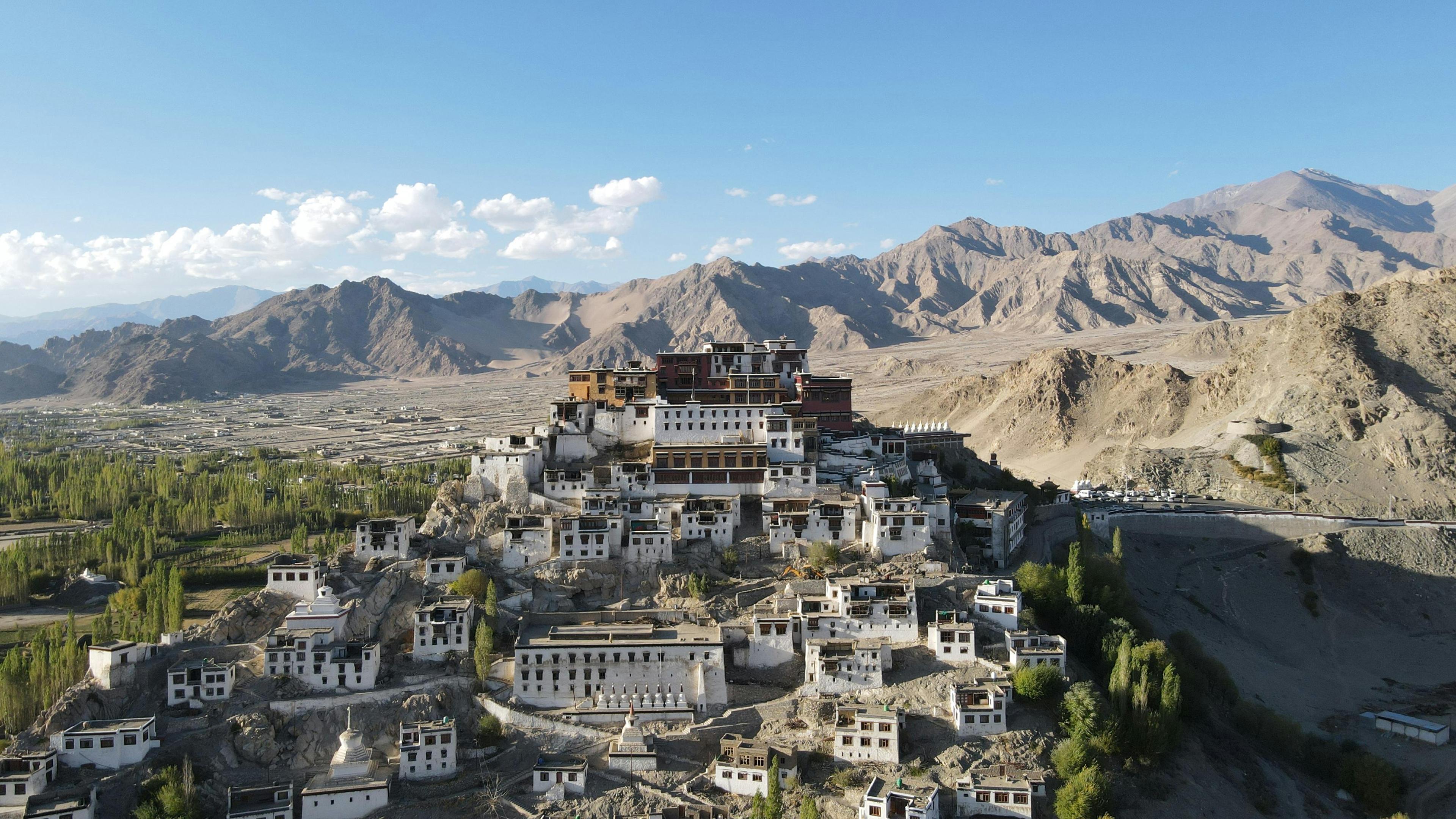
Thiksey Monastery in the Indus valley of Ladakh rises on a conical hill in twelve storeys of whitewashed stone and mud brick, its upper tiers painted in ochre and maroon, the whole complex visible from fifteen kilometres across the flat valley floor. From a distance it looks like part of the geology. Up close it resolves into courtyards, prayer halls, cells, kitchens, storerooms, and shrines built across eight centuries in a continuous accumulation that has no single design moment but that achieves a visual coherence from the consistency of materials and the logic of the site.
Inside, the prayer halls are dark and fragrant with butter lamps and incense. The walls are covered floor to ceiling in murals and tangka paintings depicting the Tibetan Buddhist cosmological universe: the wheel of existence, the paradise of Amitabha, the fierce guardians of the dharma, the lineages of teachers and students stretching back to the historical Buddha. The scale and quality of the painted programmes in the great Ladakhi monasteries — Alchi, Lamayuru, Likir, Spituk — represent a continuous tradition of sacred painting that spans a thousand years in a single region.
Alchi stands apart. Its choskor, the original temple complex founded in the 11th century, contains murals of extraordinary quality that represent the high point of Kashmiri artistic influence in the trans-Himalayan region. The Sumtsek, a three-storey shrine building, contains gigantic painted clay bodhisattva figures whose garments are covered in tiny narrative paintings depicting scenes from the bodhisattva's previous lives — compositions of such miniaturist intricacy that close examination reveals individual scenes no larger than a postage stamp painted with brushes of one or two hairs.
Historical Significance
The Buddhist monasteries of the Himalayan region are not primarily architectural monuments. They are knowledge institutions. The monastery is the place where the full Tibetan Buddhist curriculum — philosophy, logic, medicine, astronomy, ritual, art, and the esoteric practices of Vajrayana — is transmitted from teacher to student through a system of structured study, debate, and practice that has produced one of the most sophisticated contemplative and philosophical traditions in human history. The buildings are the infrastructure of this transmission, and their survival is inseparable from the survival of the living institutions they house.
In Tibet itself, the Cultural Revolution (1966–1976) destroyed approximately 6,000 monasteries, burning their libraries, shattering their statues, and dispersing their communities. The loss to Tibetan cultural heritage was enormous and irreplaceable. The monasteries of Ladakh survived the Cultural Revolution intact because Ladakh is Indian territory, and the tradition they maintain — including the complete Tibetan Buddhist curriculum and the living communities of monks who practise and teach it — represents what was destroyed in Tibet at scale.
The Story
10th–11th Century CE — Foundation Period The second diffusion of Buddhism into Tibet and the Himalayan region drives the construction of the first great monastery complexes. Rinchen Zangpo, the Great Translator, is credited with founding over one hundred temples across Ladakh and western Tibet, including Alchi. The murals he commissions in the Alchi choskor represent the state of Central Asian Buddhist art at its greatest cross-cultural moment.
14th–17th Century CE — Classical Expansion The major monastery complexes of Ladakh — Hemis, Thiksey, Lamayuru, Diskit — are founded or substantially expanded during this period. The Gelug school, founded by Tsongkhapa in the 14th century, establishes a network of monasteries across Tibet and the Himalayan region, eventually producing the Potala Palace in Lhasa as the seat of the Dalai Lama's theocratic government.
17th Century CE — Potala Palace The fifth Dalai Lama constructs the Potala Palace in its current form above Lhasa, completing the most iconic structure in Tibetan Buddhist civilisation. The thirteen-storey palace contains over 1,000 rooms and houses the tombs of successive Dalai Lamas.
1966–1976 — Cultural Revolution Chinese Red Guards and local cadres destroy approximately 6,000 monasteries across Tibet. Libraries are burned, statues destroyed, and monastic communities dispersed. The full extent of the destruction is still being assessed.
1980s — Partial Reconstruction Limited reconstruction of some Tibetan monasteries is permitted following post-Mao political reforms. The Potala Palace is preserved and eventually UNESCO-inscribed in 1994. Access for international conservation expertise remains restricted.
Present — Two Himalayan Realities Ladakhi monasteries operate as living institutions with active monastic communities, conducting annual festivals, maintaining traditional arts, and transmitting the full Tibetan Buddhist curriculum. Tibetan monasteries operate under Chinese government restrictions on monastic recruitment, education content, and political expression. The two situations represent two different trajectories of the same tradition.
Threats and Risk Assessment
The Tibetan Political Context In Tibet, the threats to the monastic tradition are primarily political. The Chinese government's restrictions on the number of monks permitted in specific monasteries, the requirement that monks receive "patriotic education" in government-approved content, and the monitoring of religious practice create conditions in which the full transmission of the Tibetan Buddhist curriculum is not possible within Tibet itself. The exile communities in India maintain the uninterrupted tradition, but the physical heritage of Tibetan civilisation remains within Tibet, under conditions that limit the free exercise of the living tradition that gives that heritage its meaning.
Climate and Physical Fabric In Ladakh, the physical threats to the monastery buildings are primarily climatic. The earthen and lime-plaster construction that characterises Himalayan Buddhist architecture is vulnerable to moisture. The glacial water sources that fed the agricultural systems supporting monastic communities for centuries are retreating. Increased rainfall intensity, a consequence of changing monsoon patterns, is causing erosion damage to earthen structures that were designed for a drier climate. The traditional lime plaster that protected mural surfaces has specific hydrological properties; its replacement with modern cement traps moisture and accelerates rather than prevents deterioration.
Research and Scholarly Context
The Tibet Heritage Fund has conducted the most systematic conservation work in Ladakhi and Tibetan monasteries, producing methodological guidance for earthen architecture conservation in high-altitude environments. Roger Goepper's work on the Alchi murals is the primary scholarly resource for that site. The Tibetan Buddhist Resource Center maintains the most comprehensive digital archive of Tibetan Buddhist texts. CyArk's documentation provides spatial baselines for deterioration monitoring. The Central Institute of Buddhist Studies in Leh maintains research capacity within Ladakh.
If Nothing Changes
The murals of Alchi have survived for over nine hundred years in a climate that should have destroyed them many times over — the dry cold of the Indus valley preserves what the humid tropics would have dissolved. They will survive for another nine hundred years if the buildings that protect them are maintained, if the moisture conditions inside the shrines are managed, and if the living community that regards them as sacred continues to exercise its custodial function. None of these conditions is guaranteed. Climate change is altering the moisture balance of the valley. Traditional maintenance knowledge is declining. And in Tibet, where the scale of monastic culture is vastly larger, the cultural revolution's destruction and the current political restrictions mean that the buildings that survived exist without the full living tradition they were designed to house. A monastery without monks is a building. A monastery with monks who are monitored, restricted, and required to profess beliefs contrary to their tradition is something harder to name. The physical fabric of Himalayan Buddhist civilisation will outlast its current political difficulties, as it has outlasted many previous ones. Whether the living tradition it houses will remain intact through those difficulties is the question that the next generation will answer.
Screening Room

Ladakh: The Land of High Passes — BBC Documentary
Historical Timeline
Foundation Period
Second diffusion of Buddhism into Tibet and Himalaya. Rinchen Zangpo founds temples including Alchi. The great Alchi murals are commissioned.
Classical Expansion
Major Ladakhi monasteries founded. Gelug school establishes a network across Tibet and the Himalayan region.
Potala Palace Built
The Fifth Dalai Lama constructs the Potala Palace in Lhasa, the defining monument of Tibetan Buddhist civilisation.
Cultural Revolution Destruction
Approximately 6,000 Tibetan monasteries destroyed. Libraries burned, statues shattered, communities dispersed.
Potala Palace UNESCO Inscription
The Historic Ensemble of the Potala Palace is inscribed on UNESCO's World Heritage List.
Diverging Trajectories
Ladakhi monasteries continue as living institutions. Tibetan monasteries operate under Chinese government restrictions.
Quick Facts
Location
Ladakh, India (Hemis, Thiksey, Diskit, Alchi); Tibet Autonomous Region, China (Potala Palace, Tashilhunpo); broader Himalayan belt
Country
India
Region
South Asia / Himalayan
Period
Alchi monastery complex 11th century CE; major monastic development across the Himalayan belt from the 10th to 17th centuries CE; Potala Palace as current structure 17th century CE; Lhasa UNESCO inscribed 1994; living institutions to present
Type
Built Heritage
Risk Level
At Risk