
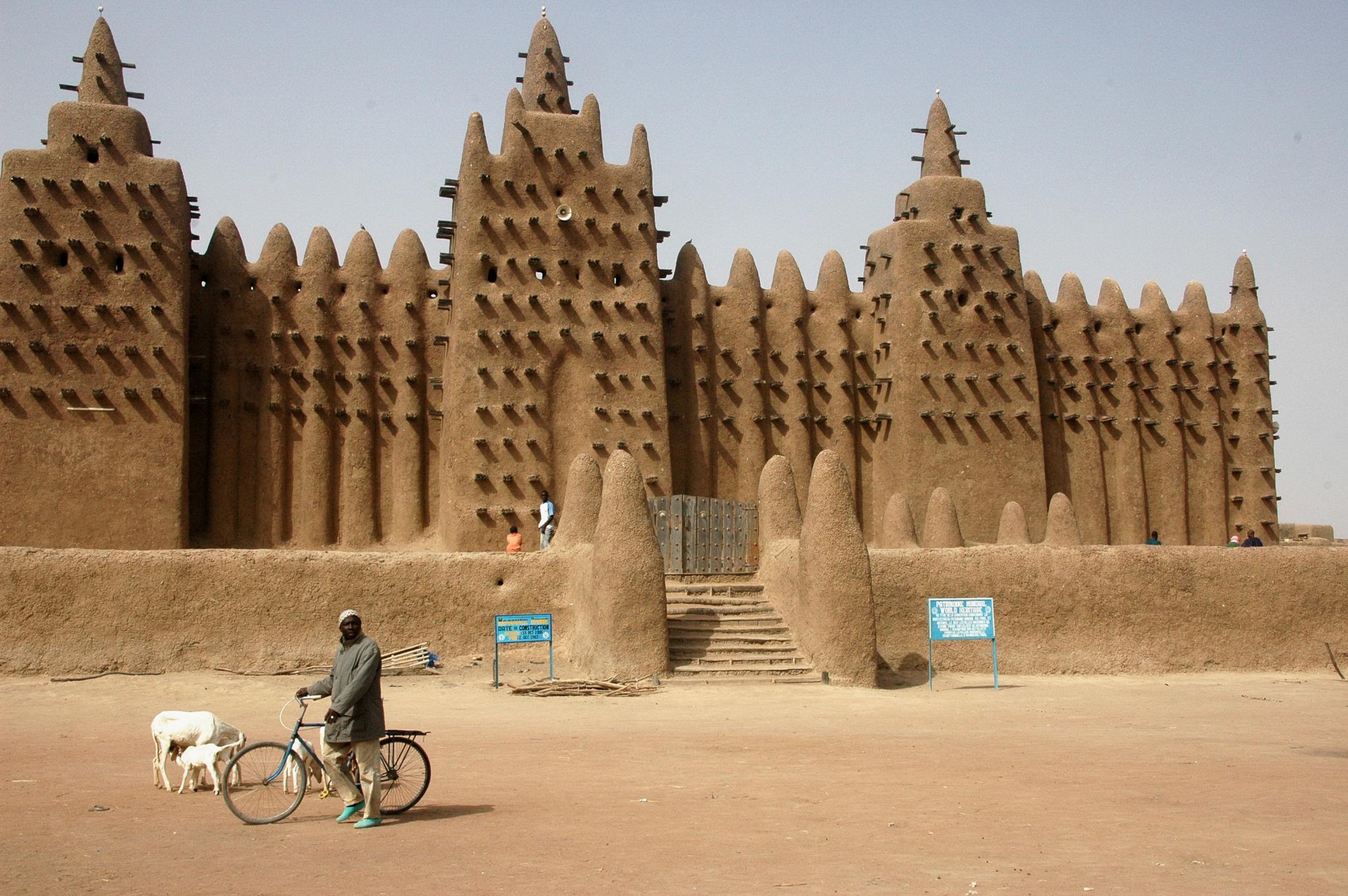
Great Mosque of Djenné
Interactive 3D Scan
Explore 3D Model
Click to load interactive scan
Great Mosque of Djenné
Djenné, Mali · 13th Century CE to Present · Sudano-Sahelian Architecture Risk Level: At-Risk
Site at a Glance
Location: Djenné, Mopti Region, Mali Coordinates: 13.9054° N, 4.5550° W Type: Built Heritage Sub-types: Islamic Religious Architecture, Earthen Architecture, Living Heritage Period: First mosque on site approximately 13th century CE; current structure 1907; UNESCO inscribed 1988 Risk Level: At-Risk UNESCO Status: Inscribed 1988 (as part of Old Towns of Djenné)
3D Documentation
The CNRS (French National Centre for Scientific Research) has conducted photogrammetric documentation of the mosque and Old Town of Djenné. The Getty Conservation Institute produced a comprehensive assessment of earthen architectural conservation practices at Djenné. CyArk has documented the mosque in 3D as part of its African heritage programme, with materials available through openheritage3d.org. A Sketchfab model provides accessible 3D access for researchers and educators. Access to the mosque for documentation has been intermittent due to the regional security situation in Mali.
- CyArk Open Heritage — Mali documentation: https://openheritage3d.org/
- Getty Conservation Institute — Earthen Architecture: https://www.getty.edu/conservation/
- UNESCO dossier: https://whc.unesco.org/en/list/116
Site Description
The Great Mosque of Djenné rises from the flood plain of the Bani River, a tributary of the Niger, on a raised platform that protects it from seasonal flooding. It is approximately 75 metres wide and 75 metres deep. Three towers mark the qibla wall facing Mecca, each capped by an ostrich egg symbolising fertility and purity and containing the wooden structural poles — bundles of rodier palm sticks called toron — that project from the walls at regular intervals and serve a structural purpose: they provide permanent scaffolding for the annual replastering.
The walls of the mosque are approximately 41 centimetres to 61 centimetres thick. They taper as they rise, giving the building its characteristic buttressed silhouette. The interior holds roughly 3,000 worshippers. The courtyard, open to the sky, can accommodate additional thousands for Friday prayers and major festivals. The entire complex is made from banco: a mixture of mud, rice husks, and water that is formed into bricks, dried in the sun, and then plastered repeatedly to create the smooth rounded forms characteristic of Sudano-Sahelian architecture.
Historical Significance
Djenné was one of the great trading cities of medieval West Africa, positioned at the convergence of the Saharan caravan routes and the Niger River system, controlling the flow of gold from the Bambuk and Bure goldfields to the north and the trans-Saharan traders who moved salt, copper, and manufactured goods southward. The city's wealth funded the construction of a mosque that signalled its importance as a centre of Islamic learning and commerce. Ibn Battuta, passing through the region in the 14th century, described Djenné as a city of extraordinary prosperity.
The mosque is made of the same material as the landscape it stands in. Banco is not a compromise material. It is what the climate and ecology of the Sahelian zone provide, and the architectural tradition that developed around it over seven centuries represents a profound adaptation of religious architecture to local resources and conditions. The annual replastering festival, the Crepissage de la Grande Mosquée, is inscribed on UNESCO's Representative List of Intangible Cultural Heritage alongside the building itself.
The Story
c. 13th Century CE — First Mosque The King of Djenné, Koi Kunboro, converts to Islam and orders the construction of a mosque on the site of his former palace. This original mosque, described by Arab travellers as enormously impressive, begins the tradition of earthen religious architecture that will eventually produce the current structure.
1834 — Demolition by Sékou Amadou Sékou Amadou, the Fulani Islamic reformer who conquers Djenné, orders the mosque demolished on grounds that the celebrations accompanying Friday prayers are un-Islamic. The site remains unused for decades.
1907 — Current Structure Built Under French colonial administration, the current mosque is built using traditional methods and the traditional Sudano-Sahelian form. Despite being less than 120 years old, the structure follows the centuries-old architectural tradition precisely.
1988 — UNESCO Inscription The Old Towns of Djenné, including the Great Mosque, are inscribed on UNESCO's World Heritage List.
2012 to Present — Security Crisis Armed conflict in northern and central Mali following the 2012 Tuareg rebellion and the spread of jihadist groups destabilises the Mopti Region where Djenné is located. UNESCO places the Old Towns of Djenné on its List of World Heritage in Danger in 2016 due to deterioration of the earthen fabric and the disruption of conservation programmes by the security situation.
Threats and Risk Assessment
Climate and Material Vulnerability Banco is intrinsically vulnerable to rainfall. The annual replastering festival is not a tradition for its own sake. It is a structural maintenance requirement. As climate change increases the intensity of rainfall in the Sahel — a trend documented across the region — the rate at which rain erodes the mosque's plaster is increasing. The annual replastering, while celebrated, may not be sufficient to compensate for more intense erosive episodes between festivals.
Security and Access The security situation in the Mopti Region has significantly restricted UNESCO monitoring missions, international conservation expertise, and the international tourism that provides income to the local community and some funding for maintenance. Conservation programmes that require external expertise and funding have been disrupted by an inability to safely access the site. The mosque is maintained by the community, but the systematic monitoring and technical support that the UNESCO designation requires has been impaired.
Knowledge Transmission The practical knowledge of banco construction, the mixing ratios, the application techniques, the timing of work relative to the rains, the identification of the specific clay deposits that produce the right material: this knowledge is held by specific families of masons in Djenné who have maintained it across generations. As younger men leave for cities and the economic disruption of the conflict period reduces local income, the transmission of this knowledge faces the same pressures as any traditional craft community under economic stress.
Research and Scholarly Context
The Getty Conservation Institute's work on earthen architectural conservation at Djenné produced internationally significant findings on the performance of banco under climate stress. The CNRS has conducted architectural documentation. CyArk's 3D documentation programme provides baseline geometric data against which future deterioration can be measured. The UNESCO/ICOMOS periodic reporting system, while disrupted by the security situation, provides the most comprehensive official assessments. The inscription of the Crepissage festival on the ICH Representative List recognises the intangible dimension of the site's heritage.
If Nothing Changes
The Great Mosque of Djenné is maintained by the community that worships in it. This is its strength and its vulnerability simultaneously. As long as the community is intact, present, and economically capable of organising the annual replastering, the building will survive. If the community is disrupted by conflict, by economic migration, by the loss of the specialised mason knowledge that guides the replastering, the building will begin to deteriorate faster than the community can repair it. The climate is adding a new variable: more intense rainfall is eroding the plaster more aggressively between annual festivals, and the community's traditional maintenance schedule may need to be supplemented by additional replastering events that the traditional festival calendar does not include. The mosque has been rebuilt on this site since the 13th century. The tradition of rebuilding is itself part of the heritage. The question is whether the conditions that make rebuilding possible, community cohesion, craft knowledge, physical security, sufficient rainfall but not too much, will continue to exist.
Screening Room

Djenné: The Living Mosque of Mali

The Annual Replastering of the Great Mosque
Historical Timeline
First Mosque Built
King Koi Kunboro converts to Islam and builds the first mosque on the site of his former palace.
Ibn Battuta's Account
The Moroccan traveller describes Djenné as a city of extraordinary prosperity at the crossroads of trans-Saharan trade.
Demolition by Sékou Amadou
The Fulani reformer orders the mosque demolished; the site remains unused for decades.
Current Structure Built
The current mosque is built under French colonial administration using traditional Sudano-Sahelian methods.
UNESCO Inscription
Old Towns of Djenné, including the Great Mosque, are inscribed on UNESCO's World Heritage List.
World Heritage in Danger
UNESCO places Djenné on its Danger List due to fabric deterioration and the disruption of conservation by armed conflict.