
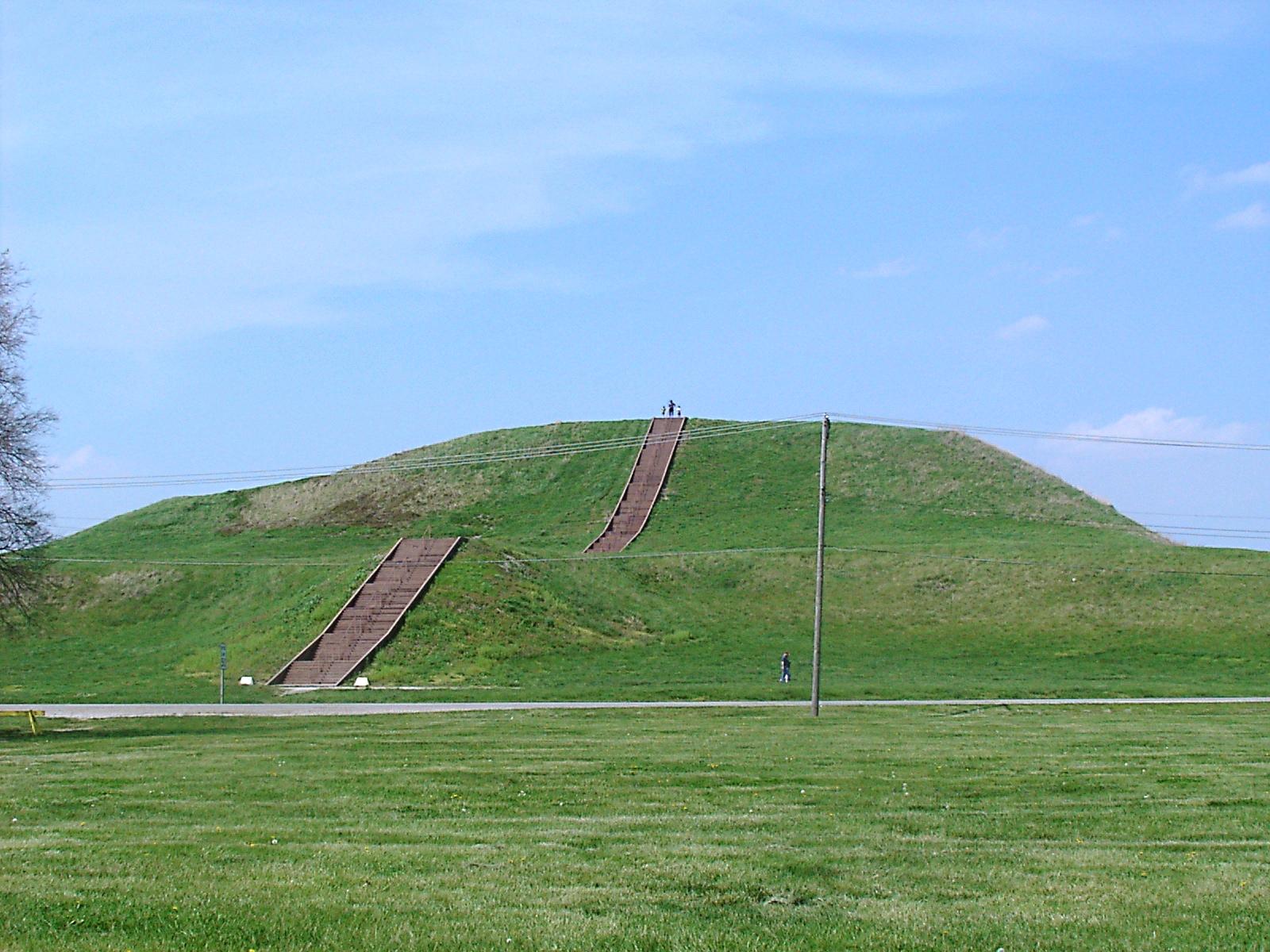
Cahokia Mounds State Historic Site
Interactive 3D Scan
Explore 3D Model
Click to load interactive scan
Cahokia Mounds State Historic Site
Illinois, USA · c. 900–1350 CE · Mississippian Culture Risk Level: At-Risk
Site at a Glance
Location: Collinsville, Madison County, Illinois, USA Coordinates: 38.6552° N, 90.0619° W Type: Built Heritage Sub-types: Archaeological Site, Pre-Columbian City, Earthwork Architecture Period: Mississippian culture; city flourishing approximately 900–1350 CE; peak 1050–1150 CE; UNESCO inscribed 1982 Risk Level: At-Risk UNESCO Status: Inscribed 1982
3D Documentation
The Illinois State Archaeological Survey (ISAS) has produced LiDAR surveys of the Cahokia site and surrounding mound groups, available through the Illinois State Geological Survey. The Smithsonian Institution's National Museum of the American Indian holds extensive Mississippian culture collections and research materials at americanindian.si.edu. A photogrammetric model of Monks Mound is available on Sketchfab. Open Context at opencontext.org hosts archaeological data from Cahokia excavations.
- Illinois State Archaeological Survey: https://isas.illinois.edu/
- Smithsonian NMAI: https://americanindian.si.edu/
- Open Context — Cahokia Data: https://opencontext.org/
- UNESCO dossier: https://whc.unesco.org/en/list/198
Site Description
Monks Mound stands 30 metres above the surrounding floodplain and covers 5.6 hectares at its base. It was built in stages over approximately 300 years, entirely from earth carried in baskets by labourers without wheelbarrows, pack animals, or mechanical assistance. The volume of earth moved to construct it — approximately 623,000 cubic metres — is comparable to the Great Pyramid of Giza, which it slightly exceeds. A substantial wooden building, estimated to have been 30 metres tall, once stood on its summit, making it the most dominant architectural feature in a city that could have been seen for miles across the Mississippi floodplain.
The site includes 120 surviving mounds of various types: platform mounds that supported buildings, conical mounds for burial, and ridgetop mounds whose function is debated. Originally the site contained an estimated 200 mounds in a planned urban layout. The central plaza, a levelled area approximately 19 hectares in extent, was the civic heart of the city, flanked by mounds of varying size in a planned spatial arrangement that reflects sophisticated urban design. A wooden palisade enclosed the central precinct. Outside it, the city extended across a planned grid of neighbourhoods, markets, and residential areas that archaeological survey continues to reveal.
Historical Significance
Cahokia at its peak around 1100 CE was, by population estimate, larger than London at the same date. It controlled a trade network that extended from the Gulf of Mexico to the Great Lakes, from the Atlantic seaboard to the Great Plains, moving copper, marine shells, mica, and other prestige materials across distances of thousands of kilometres. The city's planning, with its central plaza, hierarchical mound arrangement, and structured residential zones, reflects a political and social organisation considerably more complex than the "primitive tribal" model that dominated Euro-American assumptions about pre-Columbian North America.
The Cahokians left no writing. Their language is not known. Their theology is inferred from archaeology, art, and comparison with historically documented Mississippian cultures. Their identity is a question: the city was abandoned around 1350 CE, and no Native American group has unambiguously claimed Cahokia as their ancestor city. Some Dhegihan Siouan groups, Osage and Quapaw, and some Algonquian groups have cultural connections to the Mississippian tradition, but the specific ancestral connection to Cahokia's population remains contested.
The Story
c. 700–900 CE — Early Settlement Small Woodland period farming communities occupy the American Bottom, the broad floodplain of the Mississippi River near the confluence with the Missouri. The rich agricultural land and river access create conditions that will support a major urban development.
c. 900 CE — Cahokia Begins The Cahokia site begins its development as a significant settlement. The distinctive Mississippian cultural pattern, characterised by platform mound construction, planned plazas, and maize-based agriculture, emerges and intensifies.
c. 1050 CE — The Big Bang Archaeological evidence indicates a sudden and dramatic intensification of construction and population around 1050 CE, sometimes called the "Cahokia Big Bang." Monks Mound reaches something close to its final form. The central precinct is enclosed by a wooden palisade. Population density reaches levels comparable to medieval European cities.
c. 1100 CE — Peak Population Cahokia at its peak houses between 10,000 and 20,000 people, with a broader urban area possibly supporting more. It is the largest city north of Mexico and one of the largest cities in the world at its latitude.
c. 1200–1350 CE — Decline and Abandonment The city gradually depopulates over approximately 150 years. The causes are debated: environmental degradation from deforestation and soil exhaustion, climate change producing drought stress, political disruption, epidemic disease, or some combination of these. By 1350 CE the city is effectively abandoned. The mounds remain, gradually eroding, for the next five centuries without any population that maintains or interprets them.
1982 — UNESCO Inscription Cahokia Mounds is inscribed on UNESCO's World Heritage List, providing the first significant international recognition of the site's significance.
Threats and Risk Assessment
Urban Encroachment The St Louis metropolitan area has expanded steadily toward and around the Cahokia site. Interstate highways bisect the outer mound group. Suburban development has destroyed or damaged an estimated 80 mounds that were documented in the 19th century. The mounds protected within the State Historic Site boundary are safe; the broader archaeological landscape of the city is not.
Underfunding Cahokia Mounds State Historic Site operates on a budget that is a fraction of what comparable sites internationally receive. The visitor centre is modest. Archaeological survey of the site has been conducted in sections over decades and has not been completed. The site receives approximately 300,000 visitors annually: significant for a state historic site but small relative to comparable sites internationally, and far below the numbers that would generate the revenue to fund comprehensive preservation.
The Awareness Gap The most significant long-term threat to Cahokia may be simple obscurity. A site that contained a larger city than contemporary London, built entirely without metal tools or draft animals, that moved more earth than the Great Pyramid, is almost unknown to the majority of Americans who live within driving distance of it. This is a failure of education and public communication rather than a conservation failure in the technical sense. But obscurity has practical consequences: low visitor numbers mean low revenue; low revenue means inadequate resources for preservation and research; inadequate research means the site remains underinterpreted; underinterpretation perpetuates obscurity.
Research and Scholarly Context
The Illinois State Archaeological Survey has conducted the most systematic research at Cahokia, with excavations and LiDAR surveys producing detailed spatial models of the city's extent and internal structure. The Cahokia Mounds Museum Society supports ongoing research. The Smithsonian's National Museum of the American Indian maintains collections and interpretive programmes. Open Context's archaeological database hosts excavation data. The UNESCO World Heritage dossier provides the formal international conservation assessment. Timothy Pauketat's work, particularly his book Cahokia: Ancient America's Great City on the Mississippi (2009), is the most accessible scholarly synthesis for non-specialist readers.
If Nothing Changes
The mounds within the State Historic Site boundary are stable. They have survived 700 years of abandonment and will survive the current century if protected. What is at risk is the broader archaeological landscape of the city: the outer mounds, the residential areas, the spatial relationships between elements of the urban plan that give the site meaning. Every suburban development project that covers an unprotected mound removes a piece of evidence that cannot be recovered. Every highway that bisects the site adds another physical barrier between elements of a planned urban landscape that can only be understood as a whole. And the gap between Cahokia's significance, one of the largest pre-Columbian cities in the world, a UNESCO World Heritage Site, a place that revises the entire narrative of North American prehistory, and its public profile, substantially smaller than that of sites a fraction of its importance, is itself a conservation problem. What is not known cannot be protected, and what is not visited cannot generate the resources that protection requires.
Screening Room

Cahokia: North America's Forgotten City

The Lost City of Cahokia — PBS Documentary
Historical Timeline
Early Settlement
Woodland period communities occupy the American Bottom floodplain, establishing conditions for urban development.
Cahokia Emerges
The distinctive Mississippian cultural pattern begins at the Cahokia site: platform mounds, planned plazas, maize agriculture.
The Big Bang
Dramatic intensification of construction and population. Monks Mound reaches near-final form. The palisade is built.
Peak Population
Cahokia houses 10,000–20,000 people. It is larger than contemporary London and one of the world's great cities.
Abandonment
The city is effectively abandoned after approximately 150 years of gradual depopulation. The reasons remain debated.
UNESCO Inscription
Cahokia Mounds is inscribed on UNESCO's World Heritage List.
Quick Facts
Location
Collinsville, Madison County, Illinois, USA
Country
United States of America
Region
North America / Midwest
Period
Mississippian culture city flourishing approximately 900 to 1350 CE; peak population approximately 1050 to 1150 CE; UNESCO inscribed 1982
Type
Built Heritage
Risk Level
At Risk