
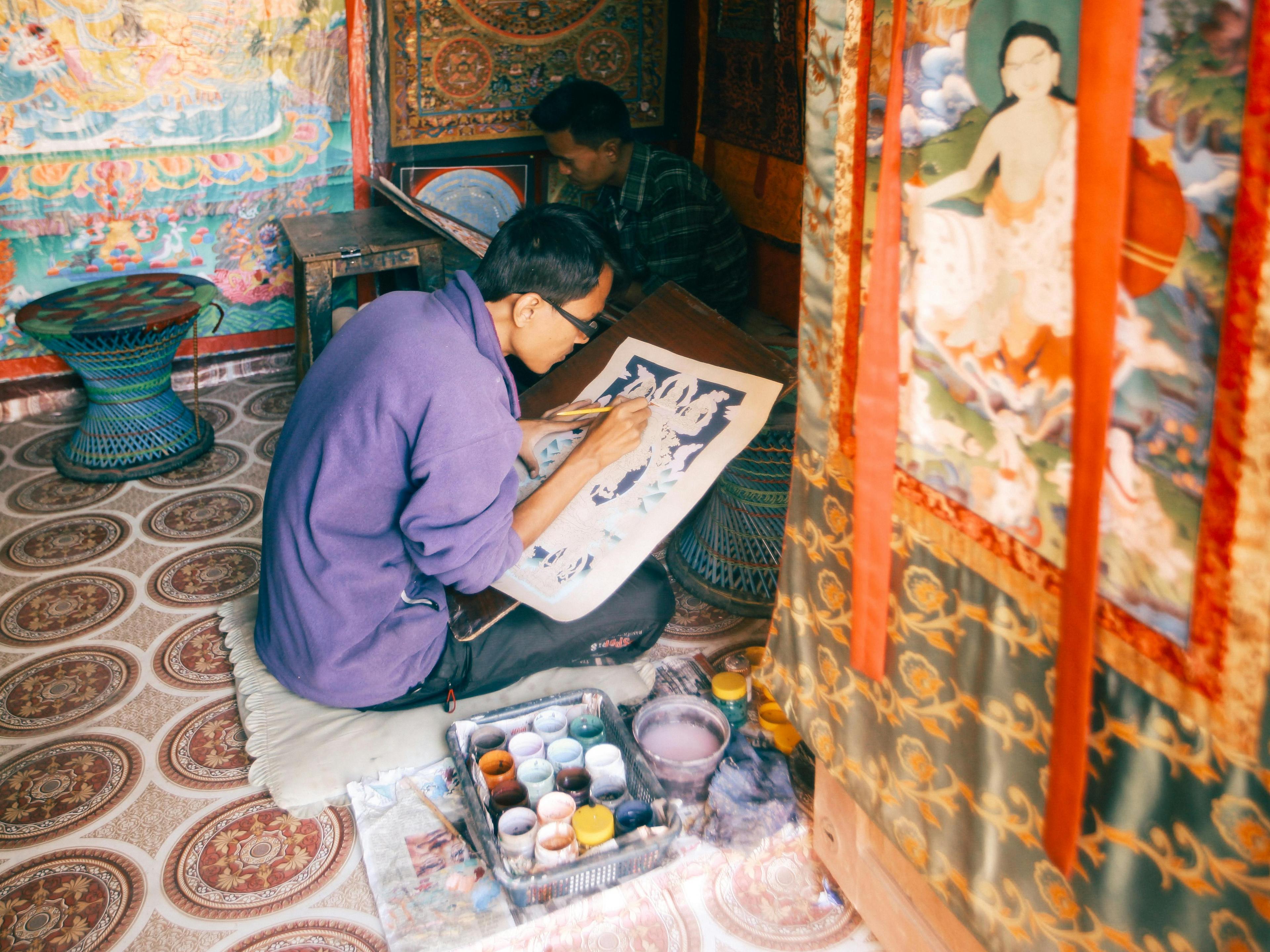
Tibetan Thangka Art
What is a Thangka?
A thangka (Tibetan: ཐང་ཀ་) is a devotional painting executed on cotton or silk, depicting Buddhist deities, mandalas, cosmological diagrams, or narrative scenes from sacred biography. It functions simultaneously as:
- An object of devotional focus for meditation practice
- A teaching aid through which complex theological relationships are made visible
- A ritual implement consecrated to carry divine presence
- A portable shrine for travel and personal practice
"The painter does not invent — he remembers. Every proportion is prescribed, every colour is a cosmological statement, every gesture a recorded truth." — Traditional maxim of the Menri school
The Production Process
Creating an authentic thangka is a months-long process governed at every stage by canonical texts:
Support Preparation
- Cotton or silk cloth is stretched on a wooden frame
- A ground of chalk mixed with animal-hide glue is applied in multiple layers
- The surface is burnished to a smooth, luminous finish
Iconometric Drawing
Using canonical proportion grids (tshad thig), the painter transfers the precise iconometric schema for the depicted deity. Every measurement — the height of the crown, the width of the shoulders, the distance between the eyes — is prescribed.
Pigment Application
Traditional pigments are ground from mineral and organic sources:
| Colour | Source |
|---|---|
| Blue | Lapis lazuli (vaidurya) |
| Green | Malachite |
| Red | Vermillion (cinnabar) |
| White | Conch shell or white lead |
| Gold | Pure gold leaf, burnished |
Consecration
The completed painting is brought to a lama for consecration (rab gnas), a ritual that activates the work as a vessel for divine presence. Without consecration, a thangka is considered a painting; with it, it is a sacred object.
The Major Schools
Menri Style (sman ris)
Founded by Menthangpa Menlha Dhondrup in the 15th century. Characterised by luminous mineral colours, balanced composition, and meticulous detail. Considered the classical standard for Tibetan painting.
Karma Gardri Style
Associated with the Karma Kagyu lineage. More expressive and painterly than Menri, with a distinctive approach to landscape elements and spatial depth derived in part from Chinese influence.
New Menri (sMan ris gsar pa)
A synthesis developed in the 17th century integrating elements from multiple schools. Currently the most practised style in diaspora communities.
Diaspora Preservation
Following the disruption of Tibetan cultural institutions in the 1960s–70s, diaspora communities have become critical repositories of thangka knowledge:
- Norbulingka Institute, Dharamsala — trains painters in traditional techniques
- Tsering Art School, Dharamsala — founded by master painter Tsering Norbu
- Shechen Monastery, Kathmandu — maintains a active painting atelier
The Authenticity Crisis
The global market for thangkas has produced a spectrum ranging from rigorous canonical works to mass-produced pieces with:
- Printed outlines hand-coloured with acrylic paint
- Omitted consecration rituals
- Iconometric errors invisible to non-specialist buyers
This makes it increasingly difficult for collectors and institutions to distinguish authentic traditional works from commercial imitations, with significant consequences for the economic sustainability of genuine practice.