
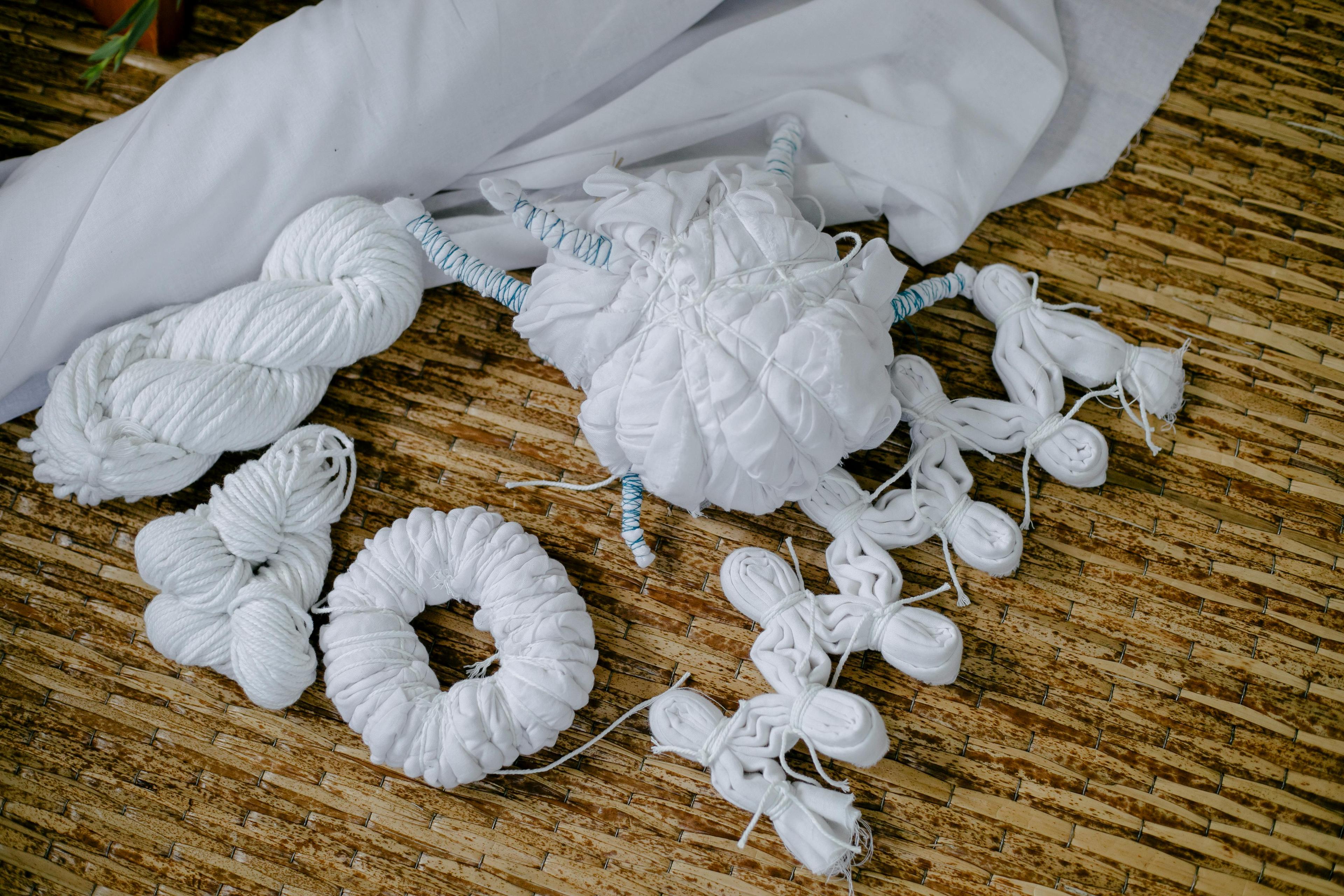
Shibori Textile Art
The Art of Controlled Resistance
Shibori (絞り) takes its name from the Japanese verb shiboru — to wring, squeeze, or press. It is not a single technique but a family of related methods sharing a common principle: fabric is shaped before dyeing so that areas under compression or tension resist the dye bath, emerging as patterns against the coloured ground.
The result is never fully predictable. Shibori is a conversation between maker and material.
Core Techniques
| Technique | Method | Visual Effect |
|---|---|---|
| Itajime | Folded, clamped between carved boards | Precise geometric patterns |
| Arashi | Wrapped diagonally around a pole, compressed | Diagonal rippled lines |
| Kumo | Fabric pleated and bound at intervals | Spider-web radiating forms |
| Ne-maki | Tightly bound around gathered fabric | Concentric rings, minute texture |
| Nuishime | Fine running stitches drawn tight | Fluid organic line patterns |
| Miura | Looped, not knotted, with a hook | Fields of small repeating O-shapes |
Arimatsu: Town of a Single Craft
The town of Arimatsu, near Nagoya, has been a shibori production centre since around 1610, when a craftsman named Takeda Shokuro developed a tie-dyeing technique to sell to travellers on the Tokaido road — the great highway connecting Edo and Kyoto.
At its peak in the Edo period, virtually every household in Arimatsu was involved in shibori production. The town developed its own vocabulary of patterns, its own master-apprentice systems, and its own community identity built around the craft.
"In Arimatsu, shibori is not a job. It is the reason the town exists." — Arimatsu-Narumi Shibori Tradition Preservation Society
The Indigo Foundation
Traditional shibori cannot be separated from natural indigo (Persicaria tinctoria, Japanese: 藍, ai). The preparation of a traditional indigo vat (sukumo) is itself a months-long fermentation process:
- Indigo leaves are composted for 100+ days to produce sukumo (dried fermented indigo)
- Sukumo is combined with wheat bran, wood ash lye, limestone, and sake in a ceramic vat
- The vat is maintained at precise temperatures and stirred daily for weeks before it becomes active
- Yarn or fabric is repeatedly dipped and oxidised to build colour depth
This knowledge — agricultural, chemical, seasonal — is as endangered as the dyeing techniques themselves.
Kyoto Shibori and the Kimono Connection
In Kyoto, shibori reached its highest technical refinement in the service of high-end kimono production. The technique of nuishime shibori — in which fine running stitches are drawn tight to create resist areas of extraordinary precision — was developed to produce the complex surface designs of luxury silk kimono worn by aristocratic and wealthy merchant classes.
A single high-grade nuishime kimono might require six months of binding work alone before dyeing begins.
Global Legacy
The publication of Yoshiko Wada's comprehensive English-language study of shibori in 1983 introduced the tradition to Western textile artists, initiating a global diffusion of the techniques. Today, shibori practice exists in textile communities across North America, Europe, and Australia.
This global presence has kept the techniques alive in adapted forms, but has also created a version of "shibori" increasingly disconnected from its Japanese material roots — particularly from natural indigo and from the specific regional knowledge systems of communities like Arimatsu.