
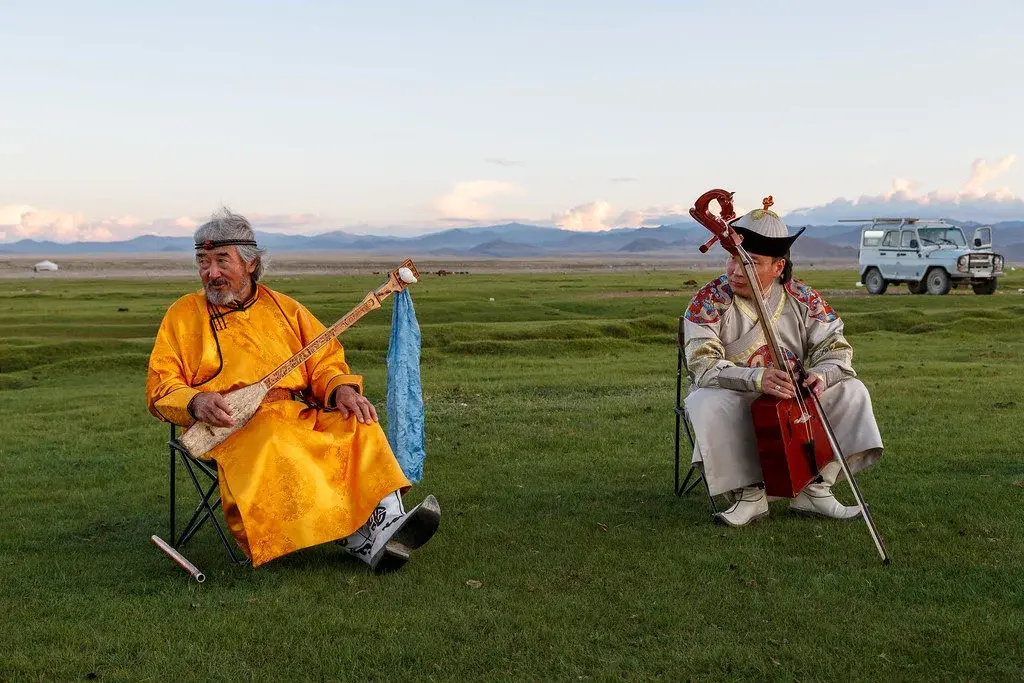
Mongolian Khoomei
The Voices of the Steppe
Khoomei (or Hooliin Chor) is the extraordinary Mongolian art of throat singing, a complex vocal technique where a single singer produces a fundamental pitch while simultaneously amplifying one or more harmonic overtones over it. The result is a mesmerizing, unearthly sound that can resemble everything from the whistling of the wind to the deep rumble of a mountain stream.
Beyond its striking acoustics, Khoomei is profoundly embedded in the animistic worldview of the nomadic herders of the Central Asian steppes, particularly in western Mongolia and the Tuva Republic (Russia). It is a sonic embodiment of the landscape itself, a method of communicating with the spirits of nature.
The Acoustics of Khoomei
To western ears trained in polyphonic choral music, Khoomei sounds impossible. How can one person sing two, or even three, notes at exactly the same time?
The fundamental principle lies in the manipulation of the vocal tract's resonances. Every physical sound, including the human voice, consists of a fundamental frequency (the base pitch we hear) and a series of naturally occurring, higher-pitched harmonic overtones. Usually, these overtones blend together, determining the timbre or "color" of a voice.
A throat singer:
- Creates a dense, powerful fundamental tone using strong breath pressure and often constricting the vocal folds or the false vocal folds (ventricular folds) to produce a tense, buzzing sound.
- Shapes the oral cavity (the lips, tongue, jaw, and velum) precisely to filter out most of the sound while heavily amplifying a single, specific harmonic overtone.
- Changes the shape of the mouth to sweeping through the harmonic series, creating a distinct, flute-like melody floating high above the constant low drone.
"When you sing Khoomei, you are not just singing a song; you are imitating the sound of nature. The low tone is the earth, and the high whistling tone is the wind blowing across the top of the mountains." — Batzorig Vaanchig, Master Throat Singer.
Primary Styles of Khoomei
While there are many sub-styles and regional variations, Khoomei generally falls into several primary categories:
- Kharkhiraa (Deep Khoomei): Characterized by a very low, harsh, growling fundamental drone produced using the false vocal cords. The overtones are usually subtle, blending into a deep, textural rumble reminiscent of a roaring waterfall or an animal growl.
- Sygyt (Whistling Khoomei): Involves a tight, piercingly clear fundamental tone with a very high, flute-like overtone melody. It requires extreme tension in the vocal tract and often mimics the whistling of wind or the calls of birds.
- Ezengileer (Stirrup): A pulsating, rhythmic style that mimics the sound of boots flapping against stirrups while riding a horse at a steady trot.
A Spiritual Ecology
For centuries, Khoomei was not considered "music" in the modern sense of a performance for an audience. It was an deeply personal, spiritual practice integrated into the daily rhythms of nomadic life on the Altai Mountains and the vast steppes.
It is deeply rooted in Tengrism, an ancient animistic and shamanic religion of Central Asia, which holds that all natural phenomena—mountains, rivers, winds, and animals—possess a spirit or life force (ezen).
Herders developed Khoomei while spending long, solitary days pastures. They sang primarily to:
- Communicate with the spirits of nature, asking for safe passage, good weather, and protection for their flocks.
- Soothe and manage livestock, particularly camels and horses during milking or when encouraging a mother to accept a rejected newborn.
- Imitate and honor the sounds of the environment, blurring the boundary between human and nature.
Traditionally, there are strong taboos associated with Khoomei. It was often sung only outdoors, and rarely by women, based on the belief that the powerful acoustic vibrations could cause infertility or difficult childbirths.
The Modern Era: Suppression and Revival
The 20th century brought rapid, traumatic changes to Mongolian culture, profoundly impacting the transmission of Khoomei.
The Soviet Era (1920s - 1990)
During the socialist period of the Mongolian People's Republic, traditional nomadic practices, particularly those associated with shamanism and religion, were heavily discouraged or actively suppressed by the state. Khoomei was often viewed as backwards and inconsistent with modern, socialist ideology. Many master singers were persecuted, and the chain of oral transmission was severely disrupted.
Simultaneously, the state bizarrely attempted to standardize and "modernize" Khoomei by bringing it into concert halls, forcing it into western musical scales and formal ensemble structures, stripping it of its spiritual context.
The Post-Soviet Renaissance
Following the democratic revolution in 1990, Mongolia experienced a massive cultural awakening. Nomadic traditions, Buddhism, and shamanism resurged.
Khoomei underwent a dramatic revitalization:
- Global Recognition: The opening of borders allowed Western ethnomusicologists and musicians to discover throat singing. Tuvan groups like Huun-Huur-Tu and Mongolian bands like The Hu (who fuse traditional instruments and Khoomei with heavy metal) have achieved massive global fame, bringing throat singing to international audiences.
- Institutional Support: Master singers re-established traditional apprenticeships. The Mongolian government actively sought, and received, UNESCO recognition, adding Khoomei to the Representative List of the Intangible Cultural Heritage of Humanity in 2009.
- Changing Gender Norms: The traditional taboos against women singing Khoomei are rapidly dissolving. Today, there are numerous highly respected female throat singers who are critical to the preservation and evolution of the art form.
Challenges to Preservation
Despite its current global popularity, the authentic, traditional practice of Khoomei remains fragile.
- Urbanization: As climate change and economic pressures drive a mass migration from the steppes to the sprawling ger districts of Ulaanbaatar, the essential connection between the singer and the natural landscape is broken. Khoomei learned in an apartment sounds fundamentally different from Khoomei learned while herding on a windy mountainside.
- Commercialization: The demand for performance-oriented Khoomei can lead to a dilution of the technique, prioritizing flashy, impressive whistling styles over the deeper, more subtle, and ecologically rooted forms like Kharkhiraa.
The future of Khoomei rests on a delicate balance: leveraging its global popularity to ensure economic support for practitioners, while fiercely protecting the deep spiritual and environmental roots that make it far more than just a vocal trick.